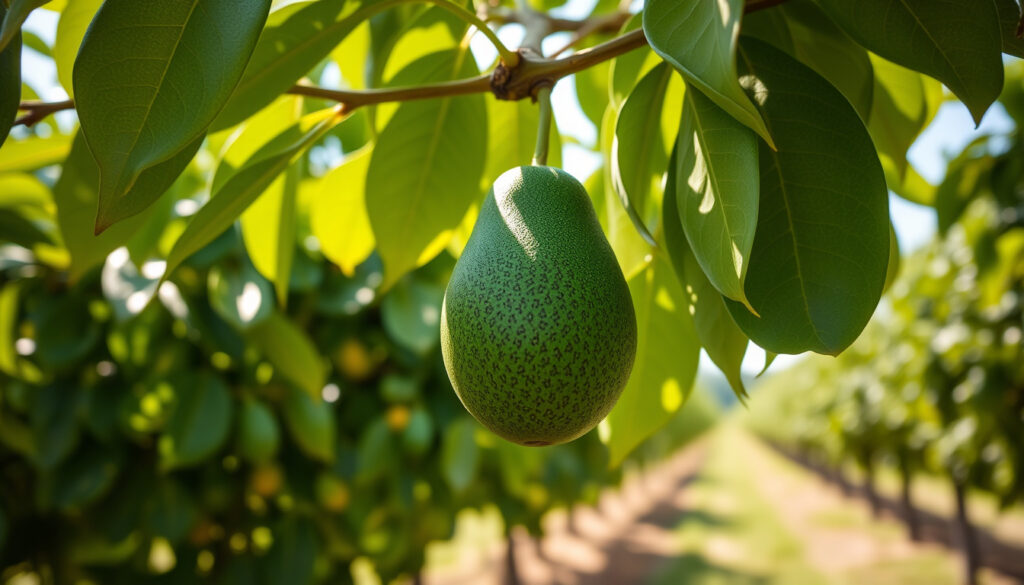
Avocado Tree Growing: Timeline, Flower Types & Care
Anyone who has tried sprouting an avocado pit in a jar of water knows the thrill of that first root. Coaxing a tree from that pit to a heavy-limbed branch of fruit takes something else entirely — and the difference between a houseplant hobby and a real harvest comes down to a handful of decisions most new growers never hear about. This guide walks through the timeline, the climate constraints, and the flower-type puzzle that determines whether your avocado tree will actually produce.
Time to fruit (seed-grown): 5–13 years ·
Time to fruit (grafted): 3–4 years ·
Mature height: 30–60 ft (9–18 m) ·
Lifespan: 50–100+ years ·
Hardiness zones: USDA 9–11 ·
Flower types: A and B
Quick snapshot
- Seed-grown trees take 5–13 years to fruit; grafted trees 3–4 years (NSW Department of Primary Industries)
- Avocado trees are tropical and cannot tolerate frost (Royal Horticultural Society)
- Best grown in USDA zones 9–11 (Home for the Harvest)
- Exact lifespan varies by variety, climate, and care (Home for the Harvest)
- Fruiting speed can vary by specific cultivar and local conditions (NSW Department of Primary Industries)
- Optimal humidity range differs between guides (Homestead and Chill)
- Year 1: Seedling emerges or grafted tree planted (GrowVeg)
- Years 3–4: Grafted tree begins fruiting (Ministry of Agriculture and Fisheries, Trinidad and Tobago)
- Years 5–13: Seed-grown tree starts fruiting (Royal Horticultural Society)
- 50+ years: Gradual decline; some trees exceed 100 years (Hunker)
- Match variety to local climate for best results (Homestead and Chill)
- Plant grafted trees for reliable fruiting (NSW Department of Primary Industries)
- Use Type A and Type B pairings to boost pollination (Ministry of Agriculture and Fisheries, Trinidad and Tobago)
Here’s your key facts table.
| Attribute | Value |
|---|---|
| Time to fruit (seed) | 5–13 years |
| Time to fruit (grafted) | 3–4 years |
| Mature height | 30–60 ft (9–18 m) |
| Lifespan | 50–100+ years |
| Hardiness | USDA zones 9–11 |
| Flower types | A and B |
| Common mistake | Overwatering causes root rot |
How long does an avocado tree take to bear fruit?
How many years from seed vs. grafted?
- Seed-grown trees: 5–13 years to first fruit (Ministry of Agriculture and Fisheries, Trinidad and Tobago)
- Grafted trees: 3–4 years to first fruit (NSW Department of Primary Industries)
- Seedlings often do not produce the same fruit characteristics as the parent tree (Royal Horticultural Society)
That gap between three years and thirteen years is the single biggest factor in whether a new grower gets discouraged or stays committed. The choice between seed and grafted stock is really a choice about how much patience you brought to the table.
What factors affect fruiting speed?
- Light exposure: full sun (6–8 hours/day) accelerates growth (GrowVeg)
- Soil drainage: well-drained, slightly acidic soil prevents root rot (Home for the Harvest)
- Temperature: ideal range 60–85°F (Homestead and Chill)
- Indoor trees rarely produce fruit without sufficient light and space (Royal Horticultural Society)
A home grower who plants a grafted tree in a warm, sunny spot with good soil can expect fruit in about four years. A seed-grown tree in the same spot will take at least five years longer — and the fruit may not resemble the avocado you ate.
The implication: if you want reliable fruit in a realistic timeframe, start with a grafted tree from a reputable nursery. Seed propagation is a fun experiment, but it is a gamble on both timing and fruit quality.
Will an avocado tree grow in Ireland?
What microclimate conditions are needed in Ireland?
- Avocado is a tropical and subtropical tree; Ireland’s cool maritime climate poses challenges (Hunker)
- RHS recommends keeping avocado plants indoors in winter at 13–18°C (55–65°F) (Royal Horticultural Society)
- Avocados are best grown in containers in a warm, bright indoor spot in cooler climates (Royal Horticultural Society)
Ireland’s average winter temperatures hover around 4–8°C, well below what an avocado tree can tolerate outdoors. A sheltered, heated greenhouse or a sunny indoor window is the only realistic option.
Can avocado trees survive frost?
- Mature trees can reportedly tolerate brief periods near 28–30°F, but frost remains a major risk (Hunker)
- USDA zone 8 may work with frost protection, but zones 9–11 are ideal (Home for the Harvest)
- Indoor or greenhouse cultivation is more reliable in Ireland (Royal Horticultural Society)
The pattern: Ireland is not avocado country unless you bring the tree indoors. The RHS guidance is clear — container growing with winter protection is the only workable path for growers in cool, maritime climates.
Where is the best place to plant an avocado tree?
What sunlight and soil conditions are ideal?
- Full sun: 6–8 hours of direct sunlight per day (GrowVeg)
- Well-drained, slightly acidic soil (pH 5.5–7.0) (Ministry of Agriculture and Fisheries, Trinidad and Tobago)
- Loamy soil texture is preferred (Ministry of Agriculture and Fisheries, Trinidad and Tobago)
- NSW guide recommends a slope facing north to east for planting (NSW Department of Primary Industries)
Good drainage is not optional — it is the difference between a thriving tree and a slow death from root rot. If your soil holds water, plant in a raised bed or a mound.
Should you plant in the ground or a container?
- Ground planting allows full size (30–60 ft) and longer lifespan (GrowVeg)
- Container planting allows mobility and frost protection for cooler climates (Royal Horticultural Society)
- Trees should be planted 4–6 metres away from structures and other trees (Ministry of Agriculture and Fisheries, Trinidad and Tobago)
- NSW guide advises setting the tree so the potting mix mark is slightly above ground level to allow for sinkage (NSW Department of Primary Industries)
A ground-planted avocado tree can live over 100 years and produce hundreds of fruits annually — but only if you have the right climate and space. A container tree may never reach full production, but it will survive a frost that would kill an in-ground tree.
The trade-off: ground planting gives you the full potential of the tree, but only if your climate cooperates. Container planting shrinks the ceiling but raises the floor — you get a living tree, not a dead one after the first cold snap.
What is the lifespan of an avocado tree?
How long do avocado trees live in optimal conditions?
- Typical lifespan: 50–100 years; some trees exceed 200 years (Home for the Harvest)
- Peak production period: years 10–30
- Gradual decline after 50+ years
An avocado tree in good soil with consistent care can outlive the person who planted it. That long arc is what makes the initial planting decisions — location, drainage, variety — so consequential.
What shortens an avocado tree’s life?
- Root rot from overwatering or poor drainage (Phytophthora) is the leading cause of early death (Ministry of Agriculture and Fisheries, Trinidad and Tobago)
- Frost and extreme weather events stress the tree
- Nutrient deficiencies weaken the tree over time
- Improper planting depth can stunt growth (NSW Department of Primary Industries)
What this means: most avocado trees die from how they were planted and watered, not from old age. Getting drainage and planting depth right on day one is the single best investment in a long harvest life.
How to tell if an avocado tree is A or B?
What is the difference between Type A and Type B flowers?
- Type A: female in the morning, male in the afternoon
- Type B: female in the afternoon, male in the morning
- This staggered schedule prevents self-pollination and encourages cross-pollination
Avocado flowers are a biological clockwork — each type opens female first, then switches to male the same day. The overlap between the two types is what allows pollen to move from one tree to another.
Do you need both types for fruit?
- Most varieties are self-fertile, but cross-pollination between A and B types boosts yield significantly
- Identify by variety name: Hass is Type A, Fuerte is Type B (NSW Department of Primary Industries)
- Planting both types within 20–30 feet improves fruit set
A single Hass tree will produce fruit on its own. But a Hass with a Fuerte nearby will produce more fruit, with better size and shape, because the flower timing overlap is wider. The pairing is a low-effort yield multiplier.
The pattern: if you have space for two trees, plant one of each type. If you only have room for one, choose a self-fertile variety like Hass and accept that you are leaving some yield on the table.
What are common avocado growing mistakes?
How does overwatering harm avocado trees?
- Overwatering causes root rot (Phytophthora), the most common cause of avocado tree death (Ministry of Agriculture and Fisheries, Trinidad and Tobago)
- Underwatering leads to leaf drop; inconsistent watering harms fruit development
- Avocado roots need oxygen — waterlogged soil suffocates them
New growers tend to water avocado trees like they water tomatoes, and that is fatal. Avocado roots are sensitive and need to dry out between waterings.
What nutrient deficiencies are common?
- Nitrogen deficiency: yellowing of older leaves, reduced growth
- Iron chlorosis: yellowing between leaf veins, common in alkaline soils
- RHS advises feeding with a general-purpose houseplant feed during spring and summer (Royal Horticultural Society)
- Poor pruning or incorrect planting depth can stunt growth (NSW Department of Primary Industries)
The implication: most avocado tree problems trace back to water management — too much, too little, or inconsistent. Get the watering rhythm right, and nutrient issues become much easier to diagnose and fix.
Here’s how the three main growing paths compare.
| Aspect | Seed-grown | Grafted | Container-grown |
|---|---|---|---|
| Time to fruit | 5–13 years | 3–4 years | 3–7 years (depends on rootstock) |
| Fruit quality | Unpredictable, may differ from parent | Reliable, same as parent cultivar | Reliable if grafted rootstock |
| Mature height | Full size, 30–60 ft | Varies by rootstock, often 15–30 ft | Limited by container, typically 6–15 ft |
| Lifespan | 50–100+ years | 40–80 years | 15–30 years (rootbound risk) |
| Climate flexibility | Needs USDA 9–11 | Needs USDA 9–11 | Can be moved indoors; works in cooler zones |
| Cost | Low (free pit) | Moderate ($30–$60) | Moderate ($40–$80 including pot) |
The verdict: For most home growers, a grafted tree offers the best balance of speed, reliability, and manageable size. Seed-grown is a long-term experiment, and container-grown is the backup for marginal climates.
Upsides
- Long productive lifespan (50–100+ years) with proper care
- High yield potential from a single mature tree (200–300 fruits per year)
- Low maintenance once established — minimal pruning needed
- Aesthetic value: evergreen canopy, attractive foliage
- Can be grown in containers for climate flexibility
Downsides
- Long wait for fruit: 3–13 years depending on propagation method
- Frost sensitivity limits outdoor growing to USDA zones 9–11
- Watering mistakes (especially overwatering) are a common cause of failure
- Requires substantial space: 30–60 ft tall, 20–30 ft wide at maturity
- Flower type synchronization needed for optimal pollination
How to plant an avocado tree: step-by-step
- Step 1: Choose a grafted tree from a nursery for reliable fruiting (NSW Department of Primary Industries)
- Step 2: Select a site with full sun (6–8 hours/day) and well-drained, slightly acidic soil (GrowVeg)
- Step 3: Plant in spring after frost danger — set the tree so the potting mix mark is slightly above ground level (NSW Department of Primary Industries)
- Step 4: Space trees 4–6 metres away from structures and other trees to allow for full canopy spread (Ministry of Agriculture and Fisheries, Trinidad and Tobago)
- Step 5: Water deeply but infrequently — let the soil dry out between waterings to prevent root rot
- Step 6: Feed with a general-purpose houseplant feed during spring and summer (Royal Horticultural Society)
- Step 7: Mulch around the base (avoid touching the trunk) to retain moisture and suppress weeds
For readers interested in other tree care guides, the principles of proper planting depth and spacing apply across species — see our guide on Magnolia Little Gem: Size, Care, and Common Problems for a similar approach to ornamental tree establishment.
Avocado tree timeline
- Year 1: Seedling emerges; grafted tree planted in final location.
- Years 3–4: Grafted tree begins fruiting.
- Years 5–13: Seed-grown tree starts fruiting.
- Years 10–30: Peak production period — the tree yields the most fruit.
- 50+ years: Gradual decline; some trees exceed 100 years with good care.
The pattern: the first decade is about patience and establishment. The second through fourth decades are the payoff. After that, it is maintenance and gradual decline — but a century-old tree still produces fruit.
What we know and what remains uncertain
Confirmed facts
- Seed-grown trees take 5–13 years to fruit; grafted trees 3–4 years (Ministry of Agriculture and Fisheries, Trinidad and Tobago)
- Avocado trees are tropical and cannot tolerate frost (Royal Horticultural Society)
- Well-drained, slightly acidic soil is essential for healthy growth (GrowVeg)
- Grafted trees are the standard choice for predictable fruiting (NSW Department of Primary Industries)
What remains unclear
- Exact lifespan varies by variety, climate, and care — some trees exceed 200 years, others die at 30
- Fruiting speed can vary by specific cultivar and local conditions
- Optimal humidity range is debated: some guides cite 60–80%, others say 45–65% (Homestead and Chill)
- Frost tolerance thresholds vary by variety and duration of exposure
The balance: the core facts are well-established by tier-1 agricultural authorities. The uncertainties are around margins — how much a specific tree will vary from the average, and how far you can push climate boundaries.
Expert perspectives
“Seed-grown avocados often do not produce the same fruit characteristics as the parent tree and generally bear later than grafted trees. Seedlings are not recommended for planting when the goal is reliable fruit production.”
— Ministry of Agriculture and Fisheries, Trinidad and Tobago (government agricultural advisory)
“Avocados are best grown in containers in a warm, bright indoor spot in cooler climates. Keep plants indoors in winter at 13–18°C (55–65°F).”
— Royal Horticultural Society (UK horticultural authority)
“The preferred planting aspect is a slope facing north to east. Set the tree so the potting mix mark is slightly above ground level to allow for sinkage.”
— NSW Department of Primary Industries (Australian agricultural research body)
Three sources, one consistent message: propagation method, climate, and planting depth are the three variables that make or break an avocado tree. Skip any one of them and the tree will struggle.
For readers interested in how environmental factors shape plant growth more broadly, our guide on Coral Reef: Definition, 4 Types, and Why They Matter explores how climate conditions determine ecosystem boundaries — a parallel to the climate constraints avocado growers face.
The avocado tree is not a set-it-and-forget-it plant. It demands the right climate, the right propagation method, and the right watering rhythm — and it rewards those who get it right with decades of fruit. For a home grower in a warm climate, the choice is clear: plant a grafted Hass in well-drained soil, pair it with a Fuerte if space allows, and water only when the soil dries out. For a grower in a cool climate like Ireland, the same logic applies, but indoors — a container-grown grafted tree in a sunny window, moved to a cool room in winter, is the only reliable path to homegrown avocados.
homesteadandchill.com, rhs.org.uk, agriculture.gov.tt, homefortheharvest.com, growveg.com, renaturefoundation.org, hunker.com, dpi.nsw.gov.au, plantandharvest.com, foodgardening.mequoda.com, housedigest.com
For those looking to understand the fruit itself before planting, basic avocado information covers the definition and pronunciation of the word avocado.
Frequently asked questions
Can I grow an avocado tree indoors?
Yes, but expect it to stay smaller and produce fruit rarely. Avocados need full sun (6–8 hours/day) and space for root development. Indoors, they are more likely to be ornamental than productive. A south-facing window or grow lights can help, but the RHS recommends container growing with seasonal outdoor placement when possible (Royal Horticultural Society).
How much sunlight does an avocado tree need?
Avocado trees need full sun — at least 6–8 hours of direct sunlight per day (GrowVeg). Less sunlight slows growth and reduces fruit production.
What type of soil is best for avocado trees?
Well-drained, slightly acidic soil (pH 5.5–7.0) with a loamy texture is ideal (Ministry of Agriculture and Fisheries, Trinidad and Tobago). Heavy clay or compacted soil holds too much water and causes root rot.
How often should I water an avocado tree?
Water deeply but infrequently — let the soil dry out between waterings. Overwatering is the most common cause of avocado tree death. A good rule of thumb: water when the top 2–3 inches of soil feel dry to the touch.
Do I need to prune my avocado tree?
Minimal pruning is needed. Remove dead or damaged branches, and shape the canopy for light penetration. Heavy pruning reduces fruit production. The NSW Department of Primary Industries advises against aggressive pruning (NSW Department of Primary Industries).
What pests affect avocado trees?
Common pests include avocado lace bug, thrips, spider mites, and scale insects. Root rot from Phytophthora is the most serious disease. Regular monitoring and maintaining tree health are the best preventive measures.
Can avocado trees grow in containers?
Yes, and it is the recommended method for growers in cool climates. Choose a large container (at least 15–20 gallons) with drainage holes, use well-drained potting mix, and move the tree indoors during winter. RHS advises this approach for UK growers (Royal Horticultural Society).
More related posts
 Stassi Schroeder: Firing, Sobriety, Kids & Net Worth
 Marlon Wayans: Net Worth, Family, LGBTQ+ Advocacy, and Career
 Borrowing Capacity Calculator – Free Australian Home Loan Guide
 Queensland School Holidays 2026: Dates, Terms & Calendar
 Hahn Super Dry 3.5: Mid Strength Lager, Carbs & Review
 Cunnamulla Hot Springs – Free Entry, Pools and Visitor Guide
 Karen Carpenter Cause of Death, Final Words & Legacy
 Cowboys Playoff Elimination 2025: Dak’s Loss & What’s Next
