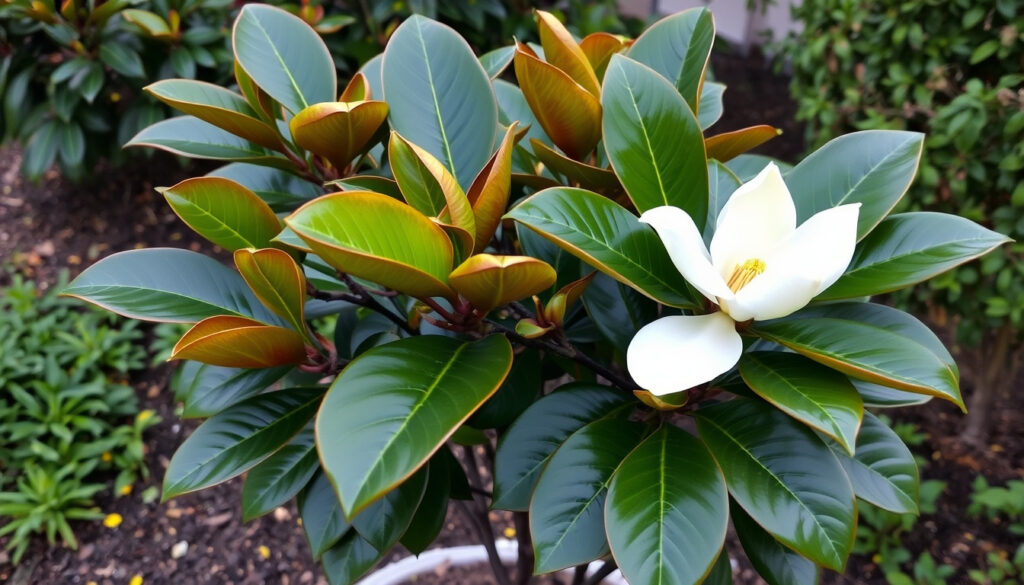
Magnolia Little Gem: Size, Care, and Common Problems
Few small trees deliver as much year-round presence as the Little Gem magnolia. With its glossy evergreen leaves and fragrant white flowers, this compact cultivar of the Southern magnolia is a favorite for tight spaces from North Carolina to Ireland. This guide draws on verified data from botanical gardens and nurseries to help you choose the right spot, care for it properly, and sidestep common problems.
Mature Height: 15-20 ft (4.5-6 m) ·
Mature Spread: 8-12 ft (2.4-3.7 m) ·
Growth Rate: Slow (1-2 ft per year) ·
Hardiness Zones: 7-9 (USDA) ·
Flower Color: White, fragrant ·
Sun Exposure: Full sun to partial shade
Quick snapshot
- Height: 15-20 ft (Missouri Botanical Garden)
- Spread: 8-12 ft (The Spruce)
- Growth: Slow (1-2 ft/yr) (NC State Extension)
- Habit: Upright columnar (Missouri Botanical Garden)
- Sun: Full sun to part shade (NC State Extension)
- Soil: Well-drained, acidic to neutral (The Spruce)
- Water: Moderate, keep moist (NC State Extension)
- Fertilizer: Balanced slow-release in spring (NC State Extension)
- Scale, spider mites, sooty mold (NC State Extension)
- Root rot in poor drainage (NC State Extension)
- Leaf spots in humid climates (NC State Extension)
- Iron chlorosis in alkaline soil (NC State Extension)
- Evergreen vs Deciduous
- White flowers vs purple-red
- Height: 15-20 ft vs 10-15 ft
- Hardiness: Zones 7-9 vs 4-8
The table below captures the defining characteristics of the Magnolia grandiflora ‘Little Gem’—a compact evergreen that fits into gardens where its full-size cousin would overwhelm.
| Attribute | Value |
|---|---|
| Botanical Name | Magnolia grandiflora ‘Little Gem’ |
| Common Name | Little Gem Magnolia |
| Family | Magnoliaceae |
| Mature Height | 15-20 ft (4.5-6 m) |
| Mature Width | 8-12 ft (2.4-3.7 m) |
| Growth Rate | Slow (1-2 ft per year) |
| Hardiness Zones | 7-9 (USDA) |
| Sun Exposure | Full sun to partial shade |
| Soil Preference | Well-drained, acid to neutral, loamy |
| Flower Color | White, fragrant |
| Bloom Time | Late spring to summer, sporadic |
| Foliage | Evergreen, glossy dark green with rusty-brown underside |
How big will a Little Gem Magnolia tree get?
What is the typical height and spread of Little Gem Magnolia?
- The cultivar reaches about 15 to 20 feet tall and 8 to 10 feet wide at maturity, according to The Spruce.
- Missouri Botanical Garden notes it grows as a compact upright multi-stemmed shrub or small tree to 20 feet tall over the first 20 years.
- The NC State University Plant Toolbox describes it as a compact, upright, multi-stemmed shrub or small tree.
How fast does Little Gem Magnolia grow?
Growth is slow—typically 1 to 2 feet per year, as documented by NC State Extension. Over two decades you can expect a well-placed specimen to reach the lower end of that range. Irish nurseries like Future Forests report similar rates in the island’s cooler, damp climate.
What is the mature size after 20 years?
Most authoritative sources agree on approximately 20 feet tall after 20 years. Monrovia, a large commercial grower, lists a slightly taller range of 20-25 feet, though this may reflect ideal conditions in warmer parts of USDA zone 8–9.
A 20-foot tree fits under standard power lines and beside most one-story houses. But if you need a true dwarf under 10 feet, consider a different cultivar.
Where do little gem magnolias grow best?
What type of soil does Little Gem Magnolia need?
- The NC State Extension recommends moist, organically rich, well-drained loams with an acidic to neutral pH.
- The tree is intolerant of soil extremes—both dry and wet—though it shows moderate salt tolerance for coastal gardens.
- The Spruce emphasizes that the soil must not hold standing water, as this invites root rot.
How much sun does a Little Gem Magnolia require?
Full sun—at least six hours of direct sunlight daily—produces the densest foliage and heaviest flowering. In hotter southern climates, morning sun with afternoon partial shade works well, according to The Spruce.
What are the hardiness zones for Little Gem Magnolia?
- Reliable in USDA zones 7 through 9 (NC State Extension).
- Can be grown in sheltered spots in cooler zones (e.g., zone 6 with protection), but performance is less predictable.
The pattern: Little Gem is forgiving within its range but unforgiving outside it. Gardeners in zone 6 who try to push it are accepting a gamble.
How to look after a magnolia little gem?
When is the best time to prune Little Gem Magnolia?
- The Spruce advises pruning in late winter or early spring before new growth begins. Avoid pruning in October or late fall, as this stimulates tender new growth that may be damaged by frost.
- Removal of dead or crossing branches is done at any time, but major shaping should wait.
How often should I water Little Gem Magnolia?
- Newly planted trees: water deeply two to three times per week for the first three months, suggests PlantingTree.
- Once established (after one growing season), the tree is moderately drought tolerant but benefits from about one inch of water per week in summer (The Spruce).
- Container-grown specimens may need daily watering on the hottest days.
What is the best fertilizer for Little Gem Magnolia?
Apply a balanced slow-release fertilizer (e.g., 10-10-10) in early spring. Avoid high-nitrogen formulas that promote leafy growth at the expense of flowers. The NC State Extension notes that over-fertilization can cause leaf burn.
How to mulch Little Gem Magnolia?
- The Spruce recommends a 2-3 inch layer of organic mulch (wood chips, bark) extending to the drip line, keeping it away from the trunk.
- Avoid deep cultivation under the canopy because the roots are wide-spreading and shallow (Gardenia).
Step-by-step seasonal care routine
- Late winter/early spring: Prune dead or crossing branches; apply slow-release fertilizer; refresh mulch.
- Spring to summer: Water weekly if rain is scarce; watch for scale or sooty mold; deadhead spent flowers for tidiness.
- Autumn: Reduce watering as temperatures drop; remove fallen leaves from around the base to prevent fungal spores.
- Winter (zones 7-9): Minimal care; protect container plants from freezing wind; avoid pruning.
Little Gem’s shallow root system means you cannot plant grass or dig near it. That’s a trade-off homeowners should weigh before planting in a turf lawn.
What are the common problems with little gem magnolias?
What diseases affect Little Gem Magnolia?
- Fungal leaf spots occur in humid, wet summers—especially when foliage stays wet overnight (NC State Extension).
- Root rot develops in poorly drained soils; this is the most serious disease and often fatal.
- Sooty mold grows on honeydew excreted by scale insects—unsightly but not directly harmful.
What pests attack Little Gem Magnolia?
- Magnolia scale and spider mites are the most common pests. Scale can be controlled with horticultural oil in early spring (The Spruce).
- Whitefly may appear in warm climates but rarely causes significant damage.
How to prevent yellow leaves on Little Gem Magnolia?
- Yellowing with green veins indicates iron chlorosis, common in alkaline soils. Apply chelated iron in spring to correct it.
- Water stress (both over- and under-watering) also causes yellow leaves—check soil moisture before adjusting watering.
The implication: most problems trace back to site conditions—soil pH, drainage, and watering habits—rather than the tree’s inherent weaknesses.
What’s confirmed and what’s unclear about Little Gem health
Confirmed facts
- Mature height 15-20 ft after 20 years (Missouri Botanical Garden)
- Slow growth rate 1-2 ft per year (NC State Extension)
- Hardiness zones 7-9 (multiple sources)
- Evergreen foliage, white fragrant flowers (all sources)
- Generally disease resistant under proper conditions (NC State Extension)
What’s unclear
- Exact mature size may vary by climate—Irish nurseries report smaller sizes in some contexts
- Lifespan beyond 50 years is not well documented for this cultivar
- Impact of heavy pruning on long-term health is uncertain
What is the difference between a little gem magnolia and a Jane magnolia?
Three key contrasts separate these two popular magnolias—evergreen vs deciduous, flower color and form, and hardiness range.
| Trait | Little Gem (Magnolia grandiflora) | Jane (Magnolia liliiflora ‘Jane’) |
|---|---|---|
| Foliage type | Evergreen | Deciduous |
| Flower color & shape | Creamy white, large, fragrant, cup-shaped | Purple-red outside, white inside, tulip-shaped |
| Mature height | 15-20 ft | 10-15 ft |
| Growth habit | Upright columnar | Rounded, multi-stemmed shrub |
| USDA zones | 7-9 | 4-8 |
| Bloom time | Late spring to summer (sporadic) | Mid-spring (profuse, then repeats) |
The trade-off: Little Gem gives year-round foliage but requires warmer winters; Jane loses its leaves but offers a hardier, longer bloom season for northern gardeners.
Upsides
- Compact size fits small gardens and courtyards
- Evergreen provides privacy year-round
- Highly fragrant flowers
- Slow growth means less frequent pruning
Downsides
- Not cold-hardy below zone 7
- Susceptible to root rot in heavy clay
- Shallow roots limit under-planting
- Leaf litter from rusty-brown undersides can be messy near patios
Expert quotes on Little Gem
“‘Little Gem’ typically grows as a compact, upright, multi-stemmed shrub or small tree to 20 feet tall over the first 20 years.”
— North Carolina State Extension
“A much smaller and slower growing cultivar… grows as a compact upright multi-stemmed shrub or small tree to 20′ tall over the first 20 years.”
— Missouri Botanical Garden
“Magnolia grandiflora ‘Little Gem’ is a dwarf form of bull bay. It is a small, slow-growing evergreen tree or shrub with a naturally columnar habit.”
missouribotanicalgarden.org, myperfectplants.com, monrovia.com, myperfectplants.com, plants.sc.egov.usda.gov, reddit.com, plantingtree.com, houzz.com
For a detailed side-by-side look at how these two compact magnolias differ, see our Teddy Bear vs Little Gem comparison.
Frequently asked questions
Should I fertilize Little Gem Magnolia?
Yes, with a balanced slow-release fertilizer (such as 10-10-10) in early spring. Avoid high-nitrogen mixes that promote leaves over flowers.
Can Little Gem Magnolia tolerate shade?
It tolerates partial shade but flowers best with at least 6 hours of direct sun. In dense shade, foliage thins and bloom is reduced.
Is Little Gem Magnolia disease resistant?
Generally, yes when grown in proper conditions—well-drained soil and good air circulation. The main threats are root rot from poor drainage and scale insects.
How do I propagate Little Gem Magnolia?
Propagation is usually by semi-hardwood cuttings taken in summer. Home gardeners often find it easier to purchase an established plant from a nursery.
When does Little Gem Magnolia bloom?
It flowers from late spring into summer, producing a few blooms at a time. Mature trees may have sporadic rebloom into early fall.
How to protect Little Gem Magnolia in winter?
In zones 7-9, no protection is needed. In marginal zone 6, plant in a sheltered south-facing spot and mulch heavily over the root zone. Container trees should be moved to a protected location.
Does Little Gem Magnolia have invasive roots?
No. Though the roots are shallow and wide-spreading, they are not aggressive and will not damage foundations or pipes under normal conditions.
How much does a Little Gem Magnolia cost?
Prices vary by region and size. A 3-gallon container typically costs $40–$70; larger 7-gallon specimens run $80–$150. Irish nurseries sell similar price ranges in euros.
Related reading: Coral Reef: Definition, 4 Types, and Why They Matter · Fish Sauce: What It Is, Health Effects, Substitutes & Uses
More related posts
 Connections NYT Unlimited: Free Online Play & Hints
 Lily Collins: Biography, Health, Family, Surrogacy & Films
 Hannah Ferguson: Model vs Cheek Media Founder
 Lee Jun-Ho: Facts, Dating, Children, Career & More (2025)
 Alpha Lipoic Acid – Benefits Dosage Safety Guide
 Monica Lewinsky Today: Age, Net Worth, Life After Scandal
 Ananya Pandey: Relationship Status, Age, Height & Facts
 Father’s Day 2024: Ireland Date, History & Global Guide
