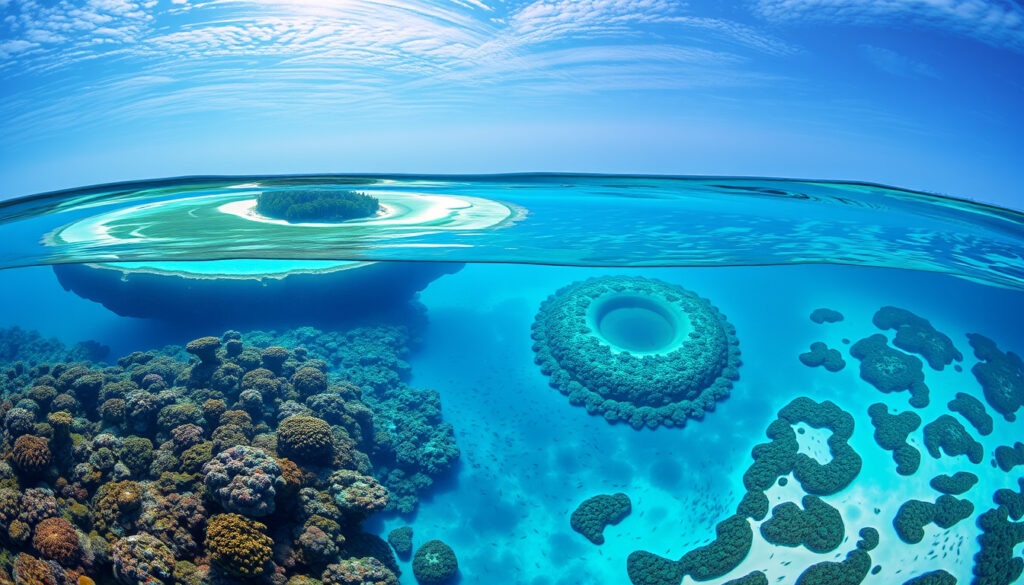
Coral Reef: Definition, 4 Types, and Why They Matter
There’s a reason coral reefs are often called the rainforests of the sea — they pack an astonishing amount of life into a small space. While tropical barrier reefs get the glory, cold-water reefs thrive in the dark depths off Ireland at 600 to 1000 meters down, and here’s what sets the four main types apart.
Number of coral species worldwide: over 2,500 ·
Depth range of cold-water corals in Ireland: 600 to 1000 meters ·
Percentage of ocean area covered by coral reefs: less than 0.1% ·
Estimated economic value of coral reefs per year: $375 billion ·
Number of major reef-building coral types: 4
Quick snapshot
- Coral reefs are built by colonies of coral polyps (NOAA Ocean Service (U.S. ocean and atmospheric agency))
- Four main reef types: fringing, barrier, atoll, patch (Coral Reef Alliance (coral conservation organization))
- Ireland has cold-water coral reefs at 600–1000 m depth (National Parks & Wildlife Service Ireland (government conservation body))
- The exact number of undiscovered coral species remains unknown (Reef Resilience Network (coral reef conservation program))
- Future impacts of ocean acidification on cold-water reefs are still under study (Reef Resilience Network (coral reef conservation program))
- Educational sources differ on whether patch reefs are a core reef class or a sub-classification (Reef Resilience Network (coral reef conservation program))
- Atolls form when a volcanic island subsides or sea level rises while coral keeps growing upward (NOAA Ocean Service)
- Fringing reefs grow directly from shore, often the first stage of reef development (NOAA Ocean Service)
- Cold-water coral reefs off Ireland are changing faster than previously thought (Marine Institute Ireland (state marine research body))
- Ocean acidification poses a growing threat to both tropical and cold-water reefs (CORDAP (global cold-water coral research initiative))
Five key facts about coral reefs, one pattern: they are all built by the same tiny animals but take dramatically different shapes depending on depth, location, and geology.
| Attribute | Details |
|---|---|
| Definition | An underwater ecosystem of reef-building corals held together by calcium carbonate skeletons. |
| Types | Fringing, barrier, atoll, patch |
| Depth range | Surface to 1000 meters (cold-water) |
| Key organism | Coral polyp (Cnidaria class) |
| Largest reef | Great Barrier Reef, Australia |
What exactly is a coral reef?
A coral reef is an underwater ecosystem held together by calcium carbonate structures secreted by coral polyps. These tiny animals, each only a few millimeters across, live in colonies that can stretch for hundreds of kilometers. The polyps extract calcium ions from seawater and secrete a hard skeleton, a process that builds the reef structure over centuries. Because of their staggering biodiversity — home to a quarter of all marine species despite covering less than 0.1% of the ocean floor — coral reefs are often called the “rainforests of the sea” (NOAA Ocean Service).
For Irish marine researchers, the discovery of cold-water coral reefs at depths of 600–1000 meters means that the “rainforests of the sea” analogy applies even to waters most people never see. Protecting these deep ecosystems is not just an environmental choice — it’s an economic one, given the $375 billion annual value of reefs worldwide.
The implication: coral reefs are not just pretty vacation destinations; they are living, growing structures that serve as the foundation for entire food webs.
What are the 4 types of coral reefs?
Scientists classify coral reefs into four main types: fringing reefs, barrier reefs, atolls, and patch reefs. Each forms under different conditions.
- Fringing reefs grow directly from the shore and are the most common type. They often have a shallow sandy bottom between the reef and the beach (NOAA Ocean Service).
- Barrier reefs run parallel to the coast but are separated by a deep lagoon. The Great Barrier Reef is the largest example (NOAA Ocean Service).
- Atolls are ring-shaped reefs that enclose a central lagoon. They form when volcanic islands subside and the coral continues growing upward (NOAA Ocean Service).
- Patch reefs are small, isolated coral outcrops found within lagoons or between larger reef systems. According to some sources, they may be a sub-classification rather than a primary type (Reef Resilience Network).
The catch: the classification works well for tropical reefs, but cold-water reefs in places like Ireland’s Porcupine Bank don’t fit neatly into these categories — they form massive carbonate mounds at depths where sunlight never reaches.
Are there any coral reefs in Ireland?
Yes — and they are nothing like the tropical postcards. Ireland is home to cold-water coral reefs, found along the continental margin at depths of 600 to 1000 meters (National Parks & Wildlife Service Ireland). These deep-sea reefs are built by species such as Lophelia pertusa, a stony coral that does not rely on sunlight for photosynthesis. Instead, it filters plankton from the ocean currents. The Porcupine Bank off the west coast of Ireland has been filmed showing cold-water corals “in abundance” (Marine Institute Ireland). These ecosystems provide habitat for commercially valuable fish, including deep-water species.
While the Irish government has protected these reefs, a 2025 report from the University Times (student newspaper) suggests that cold-water corals are “changing faster than previously thought” — a reminder that even remote deep-sea ecosystems are not immune to human pressure.
The pattern: Ireland’s cold-water reefs challenge the assumption that corals only grow in warm, sunlit waters. They also underscore the need for deeper research into ocean acidification impacts on non-tropical systems.
Why shouldn’t you touch a coral reef?
That vibrant, colorful reef you see while snorkeling has a fragile protective layer. Coral polyps are covered by a thin mucus coating that shields them from bacteria and pollutants. Touching the coral can strip away this coating, leaving the polyps vulnerable to disease and death (NOAA Ocean Service). Even a light brush can transfer oils from human skin that act as a poison to the tiny animals. NOAA guidelines recommend keeping hands, fins, and equipment at least a foot away from the reef at all times. The damage may not be visible immediately, but it can kill an entire polyp colony over weeks.
The implication: a single careless touch can destroy decades of growth. For the estimated 500 million people who depend on reef ecosystems for food and income, protecting them from direct human contact is not just a rule — it’s a survival measure.
What is another name for a coral reef?
Coral reefs are often described as the “rainforests of the sea” because of their unmatched biodiversity — they host an estimated 1–9 million species while covering less than 0.1% of the ocean floor (Coral Reef Alliance). Another common label is “marine biodiversity hotspots,” a term used by conservation biologists to highlight areas with exceptional species richness that are under threat. The ecosystem services these reefs provide — coastal protection, fisheries, tourism — have been valued at $375 billion per year globally (CORDAP).
What this means: the next time you see a crossword clue like “coral reef, 5 letters,” the answer is often “atoll” — but that only scratches the surface of what these ecosystems represent.
Confirmed facts
- Coral reefs are formed by colonies of coral polyps secreting calcium carbonate (NOAA Ocean Service).
- Four main types: fringing, barrier, atoll, patch (Coral Reef Alliance).
- Ireland has cold-water coral reefs at 600–1000 meters depth (National Parks & Wildlife Service Ireland).
- Touching coral damages its protective coating and can kill polyps (NOAA Ocean Service).
What remains unclear
- The exact number of undiscovered coral species remains unknown.
- Future impacts of ocean acidification on cold-water reefs are still under study.
- Educational sources disagree on whether patch reefs are a primary class or a sub-classification (Reef Resilience Network).
Coral reef ecosystems protect coastlines from storm surges and erosion, and they provide jobs and food for billions of people worldwide.
NOAA Ocean Service (U.S. ocean and atmospheric agency)
Irish deep-water coral reefs are changing faster than previously thought, and we are only beginning to understand the impacts of bottom fishing and ocean acidification.
Marine Institute Ireland (state marine research body)
The takeaway: coral reefs — whether in the warm shallows of the Maldives or the cold depths of the Porcupine Bank — are non-negotiable assets for the planet. For Irish marine conservationists, the choice is clear: invest in research and protection now, or watch the cold-water reefs follow the same trajectory as their tropical cousins toward collapse.
trtomsgeoinsights.com, opwall.com, universitytimes.ie, facebook.com, youtube.com, sciencedirect.com
Frequently asked questions
How long do coral reefs take to form?
Coral reefs grow at a rate of about 0.5 to 2 centimeters per year depending on species and conditions. A mature reef can take thousands of years to form.
What is the largest coral reef in the world?
The Great Barrier Reef off Australia is the largest, stretching over 2,300 kilometers.
Can you swim in a coral reef?
Yes, but only with care. Many areas are open for snorkeling and diving, but visitors are urged not to touch the reef and to use reef-safe sunscreen to avoid chemical damage.
What eats coral in a reef?
Natural predators include parrotfish, crown-of-thorns starfish, and some snails. Parrotfish scrape algae and coral, which they excrete as sand.
Do coral reefs produce oxygen?
Reefs themselves do not produce significant oxygen, but the algae (zooxanthellae) living in coral tissues produce oxygen through photosynthesis. However, the open ocean produces most of Earth’s oxygen, not reefs.
How do humans damage coral reefs?
Overfishing, pollution, runoff, and climate-change-driven warming cause bleaching and death. Bottom trawling physically destroys cold-water reefs.
Are coral reefs plants or animals?
Coral polyps are animals (Cnidaria), but they have a symbiotic relationship with microscopic algae called zooxanthellae that live inside their tissues and provide food through photosynthesis.
What is coral bleaching?
When water temperatures rise, corals expel their symbiotic algae, turning white. If the stress continues, the corals starve and die. Mass bleaching events have increased in frequency over the past three decades.
More related posts
 Crown Casino Melbourne: Royal Commission and Key Facts
 Aaron Chen: Age, Height, Net Worth, Partner, and Comedy Career
 Billy Brownless: Age, Net Worth, Friendship with Garry Lyon
 Mark Beretta: Sunrise Exit, New Partner & Net Worth
 Eid Mubarak 2025: March 30 or 31? Dates & Guide
 Connections NYT Unlimited: Free Online Play & Hints
 Manon Katseye Hiatus: What We Know About Her Absence from KATSEYE
 Finn Bennett: Biography, Movies & True Detective Role
