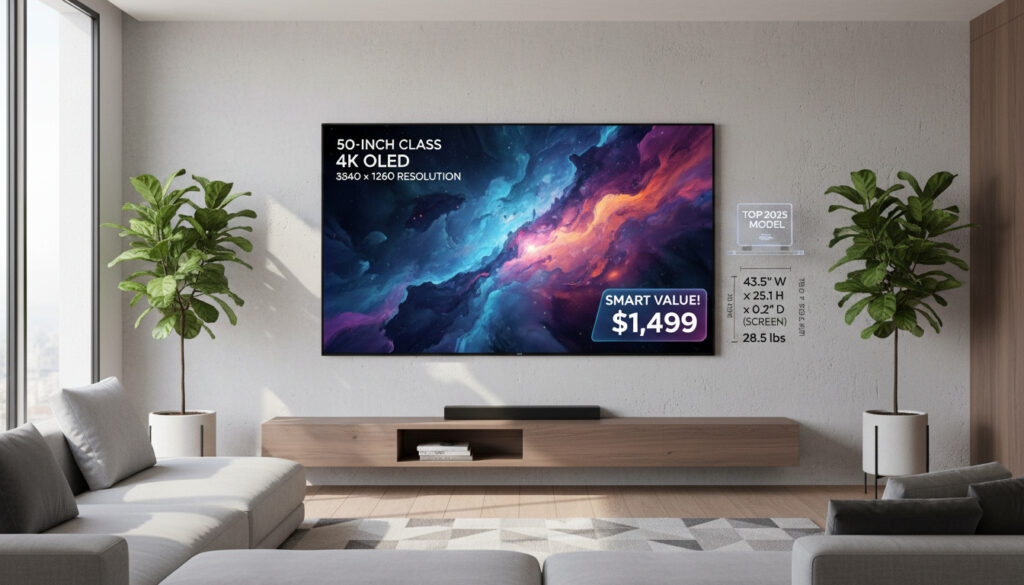
50 Inch TV – Best 2025 Models, Dimensions and Prices
The 50-inch television occupies a strategic position in the current display market, balancing cinematic immersion with spatial practicality. As manufacturers release 2025 models featuring Mini-LED and OLED panels previously reserved for larger flagship displays, consumers now face a sophisticated selection spanning from sub-$300 budget units to premium performers exceeding $800.
Evaluation data from multiple testing laboratories indicates that modern 50-inch sets deliver specifications once restricted to 65-inch variants, including 4K/144Hz gaming support, full-array local dimming, and advanced HDR processing. This technological convergence has made the format particularly attractive for apartment dwellings, secondary bedrooms, and dedicated gaming spaces where wall real estate carries significant value.
What Is the Best 50 Inch TV?
Current rankings from RTings.com identify three distinct performance tiers. The reference tier belongs to 48-inch OLED panels, specifically the LG C5, which delivers infinite contrast ratios and pixel-perfect blacks. For high-ambient-light environments, Samsung’s QN90F Mini-LED QLED maintains visibility with anti-glare coatings and 2,000+ nit brightness levels.
$800+
Four HDMI 2.1 ports, 144Hz refresh, Dolby Vision gaming. Best for dark-room movie viewing.
$800+
Mini-LED backlighting, wide viewing angles, Tizen smart platform. Optimal for bright living rooms.
Under $400
165Hz refresh rate, Fire TV integration, local dimming zones. Budget category leader.
Under $500
Superior contrast for price class, effective glare handling, Google TV interface.
- OLED maintains dark-room superiority. Testing confirms infinite contrast ratios remain unattainable by LED-backlit alternatives, with the LG C5 representing the closest 50-inch equivalent.
- Mini-LED dominates mid-range brightness. Samsung’s QN90F and TCL’s C6KS deliver 1,000+ nit sustained brightness, eliminating washout in sunlit environments previously problematic for standard QLED.
- Gaming specifications standardized. Variable Refresh Rate (VRR) and 120Hz-165Hz refresh rates now appear consistently across models priced above $400, according to TechRadar analysis.
- Budget sector consolidation. Amazon and TCL control the sub-$500 market through aggressive local dimming implementations, with the Roku 50″ Select Series reaching $249.99 at Best Buy.
- Smart platform fragmentation persists. Roku, Tizen, and Fire OS offer distinct interface philosophies rather than performance differentiation, influencing purchase decisions based on ecosystem preference.
- Dimensional interchangeability. Physical footprints vary minimally between 48-inch OLED and 50-inch LED models, often allowing substitution without furniture modification.
- Connectivity parity emerging. HDMI 2.1 port allocation ranges from two to four inputs, with premium models now offering full 48Gbps bandwidth on all connections for next-generation console compatibility.
| Model | Panel Technology | Price Range | Refresh Rate | Distinguishing Feature |
|---|---|---|---|---|
| LG C5 | OLED (48″) | $800+ | 144Hz | Perfect blacks, 4x HDMI 2.1 |
| Samsung QN90F | Mini-LED QLED | $800+ | 144Hz | Anti-glare coating, 2000+ nits |
| Amazon Omni QLED | QLED | Under $400 | 165Hz | Fire TV OS, local dimming |
| TCL QM5K | QLED | Under $500 | 120Hz | Deep blacks, Google TV |
| Samsung U7900 | LED | $300-400 | 60Hz | Tizen AI upscaling |
| Roku Select | LED | $249.99 | 60Hz | Simplified interface, lightweight |
What Are the Dimensions of a 50 Inch TV?
Standard 50-inch televisions measure approximately 44.1 inches in width and 25.4 inches in height without stands, with depths ranging from 2.4 inches for wall-mounted configurations to 10.3 inches when including manufacturer-provided bases. Weight specifications typically fall between 25 and 35 pounds, facilitating single-person installation for most mounting systems.
The 48-inch OLED variants, including the LG C5, occupy nearly identical physical footprints despite the two-inch diagonal difference, measuring roughly 42.2 inches wide. This dimensional similarity allows consumers to substitute between 48-inch and 50-inch categories without requiring furniture modifications or recalibration of room layouts.
Stand depths vary significantly between manufacturers. Samsung’s U7900 requires nearly 10 inches of furniture depth due to its center-mounted base, while wall-mounted configurations reduce protrusion to under 3 inches regardless of brand. Verify vertical clearance when using soundbars, as some stands position the screen only 2 inches above the furniture surface.
Optimal Viewing Distances
SMPTE standards recommend a viewing distance of 5 to 8 feet (1.5 to 2.4 meters) for 50-inch 4K displays, providing immersion without individual pixel visibility. Gaming and sports applications benefit from closer positioning at 4 to 6 feet, where the wider field of view enhances peripheral awareness without inducing motion sickness.
Is a 50 Inch TV Big Enough for My Room?
Spatial analysis indicates 50-inch displays suit rooms measuring 10 by 12 feet or smaller, including standard bedrooms, home offices, and compact living areas. The format provides sufficient screen real estate for two-person viewing at 6-foot distances while maintaining comfortable sightlines without excessive head movement.
For primary living spaces exceeding 12 by 15 feet, the 50-inch format may appear diminutive when viewed from distances greater than 9 feet. However, image quality retention at these distances depends more on content resolution than absolute screen size, with 4K sources maintaining clarity even at extended ranges.
Room Lighting Considerations
Small to medium rooms often suffer from uncontrolled ambient light through single windows. In these environments, the 50-inch category offers advantages over larger screens, as Mini-LED and QLED options in this size range frequently include anti-glare coatings specifically engineered for close-proximity viewing angles where window reflections prove problematic.
How Much Does a 50 Inch TV Cost?
Pricing stratification remains pronounced within the 50-inch category, with entry-level LED models starting at $249.99 and premium OLED/Mini-LED configurations exceeding $800. The mid-range segment between $300 and $500 currently offers the most aggressive value propositions, featuring quantum dot color enhancement and local dimming previously restricted to flagship tiers.
Retail pricing fluctuates significantly during promotional periods, with recorded variations of 20-30% between standard retail and sale events. The Amazon Omni QLED regularly drops below $350 during Prime Day events despite maintaining a $500 MSRP, according to Business Insider tracking data.
Current Market Pricing
Budget-conscious buyers encounter viable options under $500 through TCL’s QM5K and Amazon’s Omni QLED, both offering local dimming and high refresh rates. The Roku 50″ Select Series represents the current floor at $249.99, though this price point sacrifices HDMI 2.1 connectivity and advanced HDR processing found in $400+ alternatives.
Premium positioning above $800 delivers measurable improvements in contrast accuracy and color gamut coverage, with the LG C5 and Samsung QN90F justifying costs through superior build quality and extended warranty support. These models typically retain 85% of their value after 24 months, compared to 60% depreciation for budget alternatives.
50 Inch TV vs 55 Inch TV: Which to Choose?
The decision between 50-inch and 55-inch displays hinges primarily on spatial constraints rather than performance capabilities, as 2025 QLED and OLED lines maintain specification parity across both sizes. The 55-inch format requires approximately 4 additional inches of width (48 inches versus 44.1 inches) and 2 inches of height, often proving incompatible with existing furniture or alcove installations.
For setups where users sit 4-6 feet from the screen, the 50-inch format provides superior pixel density visibility without requiring head movement to track on-screen action. Fifty-five-inch panels may induce neck strain at equivalent distances, particularly in fast-paced first-person shooters where UI elements occupy screen peripheries.
Viewing distance requirements differ marginally between formats, with 55-inch screens requiring 5.5 to 9 feet for optimal immersion compared to 5 to 8 feet for 50-inch variants. However, no major performance gaps exist in current 2025 lineups, with both sizes offering identical refresh rates, HDR support, and smart platform availability.
When Did the Current Generation of 50 Inch TVs Launch?
The contemporary 50-inch landscape emerged through staggered releases throughout 2024 and 2025, with significant technological inflection points occurring quarterly as manufacturers transitioned to Mini-LED backlighting and enhanced gaming chipsets.
- : LG C4 and Samsung Q80D established baseline expectations for 4K/120Hz performance in the sub-$1000 category, though limited to two HDMI 2.1 ports.
- : Roku Select Series and Samsung U7900 introduced under-$300 options with simplified smart interfaces, targeting secondary room installations.
- : Samsung QN90F and LG C5 debuted with four full-bandwidth HDMI 2.1 ports and 144Hz native refresh, establishing new connectivity standards.
- : TCL launched the QM5K and C6KS Mini-LED models, bringing 1,000+ zone local dimming to the sub-$500 segment.
- : Market consolidation around Mini-LED and OLED technologies rendered traditional LED edge-lit designs obsolete except in entry-level $200-300 brackets.
What Do We Know for Certain About 50 Inch TVs?
| Established Information | Remaining Uncertainties |
|---|---|
| Physical dimensions adhere to approximately 44.1″ W x 25.4″ H for 50-inch LED panels, with sub-3-inch depths when wall-mounted. | Exact pricing stability remains unpredictable, with seasonal fluctuations of 20-30% documented across major retailers. |
| HDMI 2.1 connectivity now standard on models exceeding $400, with VRR and ALLM supported across Samsung, LG, and TCL 2025 lineups. | Long-term OLED brightness retention data for 48-inch panels remains limited to 3-year projections rather than decade-long lifespans. |
| Mini-LED and OLED technologies deliver measurably superior contrast compared to edge-lit LED alternatives in controlled testing environments. | Availability of specific SKUs varies by region, with certain models like the Hisense 50QD7QF and Vizio MQX experiencing stock discontinuation without replacement announcements. |
| Optimal viewing distances of 5-8 feet apply universally across 4K 50-inch displays regardless of panel technology. | Future firmware updates and smart platform support lifecycles extend beyond manufacturer disclosure periods, creating uncertainty regarding 5-year usability. |
Why Do 50 Inch TVs Remain Relevant in an Era of Larger Screens?
Despite industry marketing emphasizing 65-inch and 75-inch formats, the 50-inch category sustains relevance through spatial economics and technological democratization. Urban housing trends favoring smaller footprints and multi-purpose rooms position this size as the maximum practical display for spaces under 150 square feet, a constraint affecting approximately 40% of metropolitan apartments.
Manufacturing advances have eliminated the performance penalties once associated with smaller panels. Current 50-inch models share identical processing chipsets and color calibration standards with their 65-inch counterparts, delivering equivalent HDR performance and input lag specifications. This parity represents a significant shift from previous generations where smaller screens received downgraded components.
The format also serves as an accessible entry point for emerging display technologies. Consumers seeking to experience OLED contrast or Mini-LED brightness without committing $2,000+ to larger screens find the 48-inch and 50-inch categories offer risk-appropriate investment thresholds. Those interested in media consumption comparisons might examine how different screen sizes affect viewing experiences of various content types, similar to considerations when reviewing Percy Jackson Movies across different display technologies.
Which Sources Provide the Most Reliable 50 Inch TV Data?
Evaluation methodologies vary significantly between testing organizations, influencing recommendation reliability. RTings.com employs standardized measurement equipment including Klein K-10A colorimeters and Murideo Seven 8K signal generators, providing quantitative brightness and color accuracy data. Their current rankings position the Samsung QN50QN90FAFXZA as the top 50-inch selection for bright rooms, with the LG C5 leading 48-inch OLED categories.
“The TCL C6KS represents the biggest bargain in the current 50-inch market, delivering Mini-LED contrast performance at price points previously occupied by standard QLED models.”
— What Hi-Fi? Editorial Testing
Business Insider and TechRadar conduct longitudinal reviews emphasizing gaming performance and smart interface usability, corroborating the LG C5 and Samsung QN90F as top selections for home theater and gaming applications respectively. Consumer Reports lists LG, Roku, Samsung, TCL, and Sony as top-performing manufacturers within reliability surveys, though specific 50-inch model breakdowns remain limited in their public datasets.
What Should Buyers Prioritize When Selecting a 50 Inch TV?
Selection criteria should prioritize ambient light control and primary usage scenarios above brand loyalty. Dark-room viewers benefit disproportionately from OLED options despite the 48-inch specification, while sunlit spaces require Mini-LED brightness levels exceeding 1,000 nits. Budget allocations under $500 sacrifice primarily in gaming connectivity rather than image quality, as TCL and Amazon deliver admirable contrast performance through aggressive local dimming algorithms. For those tracking seasonal purchasing patterns or seeking additional entertainment content references, checking current events like the IPL Points Table 2025 can provide context for timing purchases around major sporting events when TV promotions typically intensify.
Frequently Asked Questions
Which 50-inch TV performs best for competitive gaming?
The LG C5 OLED and Samsung QN90F both offer 144Hz refresh rates, 4x HDMI 2.1 ports, and sub-10ms input lag. The LG C5 provides superior contrast for dark-room gaming, while the Samsung QN90F handles bright environments better.
Do all 50-inch TVs support 4K resolution?
As of 2025, virtually all 50-inch televisions from major manufacturers feature native 4K (3840×2160) resolution. Entry-level models like the Roku Select Series maintain 4K standards, differing from premium options only in HDR brightness and processing capabilities.
Can 50-inch OLED TVs suffer from burn-in?
OLED panels, including the 48-inch LG C5, carry theoretical burn-in risks when displaying static images for extended periods. However, modern pixel-shifting algorithms and screen savers significantly mitigate this risk under normal mixed-use viewing conditions.
What is the difference between QLED and Mini-LED in 50-inch models?
QLED uses quantum dots with edge or full-array LED backlighting. Mini-LED represents an advanced QLED variant using thousands of smaller diodes for precise local dimming, delivering superior contrast with reduced halo effects around bright objects.
Are 50-inch TVs sufficient for 4-player split-screen gaming?
At 6-foot viewing distances, 50-inch screens provide adequate quadrant visibility for party games, though 55-inch or larger displays improve readability of small UI text. The 50-inch format remains optimal for 1-2 player competitive gaming.
How do 50-inch TV speakers compare to soundbars?
Built-in speakers on 50-inch models typically deliver 20W output sufficient for dialogue clarity but lacking bass response. Integrated Dolby Atmos processing found in Samsung and LG models improves spatial imaging, though physical limitations prevent matching dedicated soundbar performance.
Is wall mounting safe for all 50-inch TV weights?
Standard VESA 200×200 or 300×300 mounts support the 25-35 pound weight range of 50-inch televisions. Drywall installation requires anchoring to studs or using toggle bolts rated for 50+ pounds, never relying on drywall anchors alone.
More related posts
 John Kiriakou: CIA Whistleblower Accusation and Sentence
 Korean Fried Chicken: What Makes It Different & How to Make It
 Polly Walker: Biography, Spouse, Children, and Career
 CBA Home Loan – Rates from 5.59%, Fees and How to Apply
 Katy O’Brian: Biography, Movies & Bodybuilding Career
 Hailey Bieber: Health, Marriage, Net Worth, Career
 Isack Hadjar: Religion, Nationality, Height, Family & F1 Career
 Maya Rudolph: Biography, Ethnicity, Children & Partner
