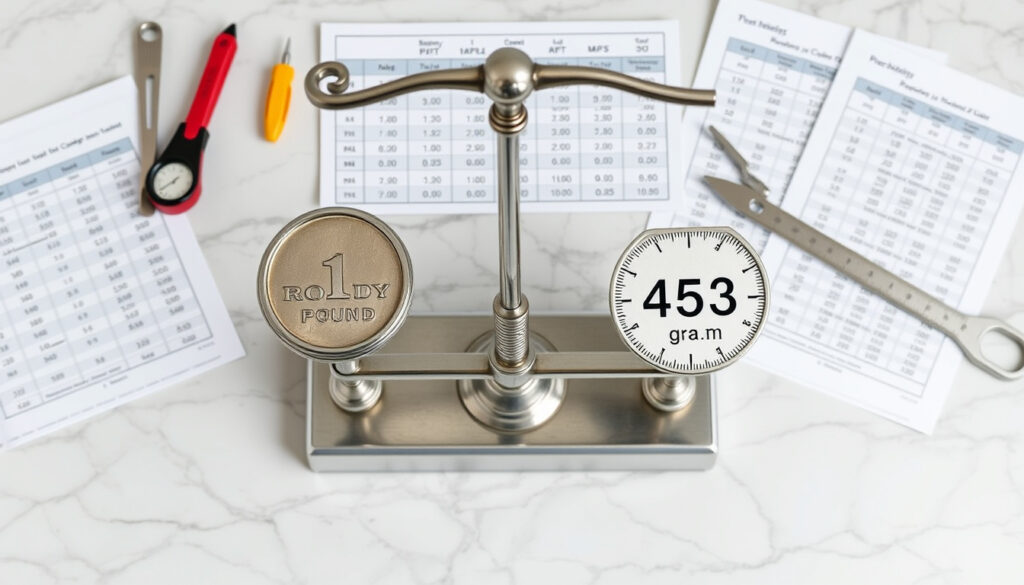
1 Pound in Grams – Exact Conversion Charts and Facts
Converting pounds to grams is a common task in baking, cooking, science, and everyday measurements. One pound equals exactly 453.59237 grams in the avoirdupois system, the standard used for most weight measurements worldwide. This precise conversion factor applies whether you are measuring flour, sugar, or general household items. Understanding this conversion helps ensure accuracy in recipes, shipping calculations, and scientific applications where precision matters.
The avoirdupois pound has been internationally standardized to ensure consistency across borders and industries. The National Institute of Standards and Technology defines the international pound as exactly 0.45359237 kilograms, which translates to 453.59237 grams. This exact figure eliminates confusion and ensures reproducible results in any context where weight conversion is needed. Many people round to 454 grams for quick estimates, but the precise value provides accuracy for professional and scientific work.
This article provides a complete guide to converting 1 pound and common multiples into grams, along with context-specific conversions for gold, flour, and baking applications. Whether you need a quick reference or detailed calculations, the following sections cover everything required for accurate pound-to-gram conversions.
How many grams is 1 pound?
One pound equals exactly 453.59237 grams in the avoirdupois system. This precise conversion factor is defined by international standards and accepted worldwide for general weight measurements. The value originates from the international agreement that established the pound as exactly 0.45359237 kilograms. All measurement tools, from kitchen scales to industrial equipment, use this standardized figure for consistency.
The avoirdupois pound used for everyday measurements contains 16 ounces and equals exactly 453.59237 grams. This system is distinct from the troy pound used for precious metals.
Quick conversion overview
Key insights for accurate conversion
- The exact conversion factor is 453.59237 grams per avoirdupois pound, established by international agreement and maintained by standards organizations.
- For quick estimates in everyday situations, rounding to 454 grams provides acceptable accuracy within 0.1% of the exact value.
- The conversion applies uniformly to all common substances including flour, sugar, and household items measured by weight.
- Precision matters significantly in baking and scientific applications where small errors compound across large quantities.
- Converting in reverse requires dividing by 453.59237: grams ÷ 453.59237 = pounds.
- The pound is legally defined as exactly 0.45359237 kilograms under the NIST conversion standards.
- Volume measurements vary by substance density, making weight-based conversions more reliable for cooking precision.
Conversion snapshot: common weights
| Pounds (lb) | Grams (g) |
|---|---|
| 1 | 453.59237 |
| 0.5 | 226.796185 |
| 2 | 907.18474 |
| 3 | 1,360.77711 |
| 4 | 1,814.36948 |
| 5 | 2,267.96185 |
| 10 | 4,535.9237 |
What are common pound to grams conversions like 1/2, 2, 3, 4, and 5 pounds?
When scaling recipes or calculating larger quantities, multiplying by the standard conversion factor produces accurate results. Each additional pound adds 453.59237 grams, making the math predictable and reliable. These scaled conversions appear frequently in grocery shopping, food packaging, and industrial applications where bulk weights matter.
Converting 1/2 pound to grams
Half a pound equals 226.796185 grams. This conversion commonly appears in recipe adjustments where a full pound of flour or sugar exceeds requirements. Professional bakers often work with half-pound increments when scaling formulas. A common flour bag of 2 pounds contains 907.18 grams, roughly four times the half-pound conversion. These smaller quantities require the same precision as larger weights to maintain recipe consistency.
Converting 2 pounds to grams
Two pounds convert to 907.18474 grams. This weight frequently appears in grocery lists and food packaging across the United States. A standard bag of all-purpose flour typically weighs approximately 2 pounds, making this conversion especially relevant in baking contexts. Kitchen scales measuring in grams can directly display the equivalent weight when a 2-pound ingredient is placed on the platform. Commercial kitchens rely on these conversions daily to maintain portion consistency.
Converting 3 pounds to grams
Three pounds equal 1,360.77711 grams. This weight often appears when preparing larger batches of dough or multiple loaves of bread. Cake recipes calling for 3-pound batter quantities use the avoirdupois pound standard for professional and home kitchens alike. Industrial food production frequently uses these weights for product scaling and quality control. Understanding the exact conversion ensures ingredients combine in proper proportions regardless of batch size.
Weighing flour in grams rather than measuring by volume produces more consistent results. A pound of flour converted to grams gives 453.59 grams, which scales accurately regardless of how the flour is packed in the measuring cup.
How many grams is 1 pound for gold, flour, or cake?
Different contexts require awareness of which pound system applies. The avoirdupois pound used for flour, cake, and everyday items differs from the troy pound reserved for precious metals. Using the wrong system produces significant errors when measuring gold or valuable materials.
1 pound of gold in grams
Gold and precious metals use the troy pound system, which differs substantially from the standard avoirdupois pound. One troy pound contains only 373.24172 grams, compared to 453.59237 grams in an avoirdupois pound. The troy system also uses 12 troy ounces per pound rather than 16 avoirdupois ounces. This distinction matters enormously when purchasing or valuing precious metals. Most jewelry and investment gold is priced per troy ounce using the troy system.
For recipes or measurements involving materials other than precious metals, always apply the avoirdupois conversion of 453.59237 grams per pound. Confusing the two systems produces errors exceeding 17% when measuring gold by weight.
The troy pound (373.24 g) used for gold is not interchangeable with the avoirdupois pound (453.59 g). Using the wrong system for precious metals results in significant valuation errors.
1 pound of flour in grams
One pound of all-purpose flour equals 453.59237 grams using the avoirdupois system. Standard bags of flour in American grocery stores typically contain 2 pounds, which translates to approximately 907.18 grams. Professional bakers prefer weighing flour rather than using volume measurements because flour settles and compacts differently depending on how it is scooped. A cup of flour can range from 120 to 140 grams depending on packing method, making weight-based measurement more reliable.
Baking guides consistently recommend gram-based weighing for accuracy. Converting pound-based recipes to grams ensures ingredients combine in proper ratios regardless of environmental factors affecting volume measurements.
How to convert 1 pound to kg and other weights?
Converting pounds to kilograms uses a straightforward calculation based on the metric definition of the pound. One pound equals exactly 0.45359237 kilograms. Dividing the gram value by 1,000 produces the same result since 453.59237 grams divided by 1,000 equals 0.45359237 kilograms. These conversions interlock mathematically through the internationally agreed definitions maintained by measurement standards organizations.
- 1 pound to kilograms: 1 lb = 0.45359237 kg
- Reverse conversion: kilograms × 2.20462 = pounds
- Quick estimate: 1 kg ≈ 2.2 lb (within 2% accuracy)
- For precise work: always use the exact factor 0.45359237
The National Institute of Standards and Technology maintains the official definitions that make these conversions universally consistent. International trade, scientific research, and medical applications all depend on these standardized conversion factors.
Established facts versus what remains unclear
Several aspects of pound-to-gram conversion are definitively established through international standards, while others require context-specific understanding.
| Established information | Context-dependent considerations |
|---|---|
| The avoirdupois pound equals exactly 453.59237 grams by international agreement. | The troy pound (373.24 g) applies only to precious metals and should not be used for general measurements. |
| The conversion factor remains constant and unchanging across all applications of the avoirdupois system. | Practical rounding for kitchen use (454 g) sacrifices precision for convenience but introduces minimal error. |
| Volume-based measurements of the same substance vary while weight-based conversions remain consistent. | Flour density varies by type and brand, affecting volume-to-weight ratios even when the pound value remains constant. |
| The pound converts to 0.45359237 kilograms with equivalent precision. | Local market practices may use regional variants; verification ensures accuracy when precision matters. |
Understanding the avoirdupois pound system
The avoirdupois system has served as the foundation for weight measurement in the United States and many other countries for centuries. Its name derives from an Old French term meaning “goods of weight” and reflects the system’s origins in trade and commerce. The international avoirdupois pound was formally defined during the 1950s international agreement on yard and pound definitions, establishing the exact equivalence to 0.45359237 kilograms that remains in use today.
This standardization enables consistent measurements across manufacturing, healthcare, research, and culinary applications worldwide. The system divides the pound into 16 ounces of 28.3495 grams each, creating a logical subdivision for practical measurements. Unlike volume-based systems that vary with substance and conditions, weight-based avoirdupois measurements provide reproducible results that scientists and professionals rely upon daily.
For those interested in learning more about related measurement conversions, exploring How Many Grams in a Teaspoon provides additional context for precise ingredient measurement in cooking and baking applications.
Official sources and reference quotes
The international avoirdupois pound is defined as exactly 0.45359237 kilograms. This definition has been in effect since 1959 and provides the authoritative conversion factor used worldwide.
— National Institute of Standards and Technology (NIST) conversion standards
The troy pound is a unit of apothecary weight, and the troy ounce is a unit of mass in the troy system. These units differ from the avoirdupois system used for most everyday measurements.
— Reference materials on weight measurement systems
Summary and practical applications
Converting 1 pound to grams requires multiplying by the exact factor of 453.59237, which produces the precise result of 453.59237 grams. This conversion applies universally to the avoirdupois system used for flour, sugar, household items, and most everyday measurements. For gold and precious metals, the troy pound of 373.24172 grams applies separately and should not be confused with the standard avoirdupois conversion. Professional bakers and scientists consistently prefer weight-based measurements over volume to ensure reproducibility across different conditions and users.
For those exploring related fitness and training measurements, the Overhead Tricep Extension guide demonstrates how understanding precise weights and measurements applies beyond cooking to athletic training and strength development.
Frequently asked questions
How many grams is 1 pound of gold?
Gold uses the troy pound system. One troy pound equals 373.24172 grams, which differs significantly from the avoirdupois pound used for everyday items. Always verify which system applies when measuring precious metals.
How many grams is 1 pound of flour?
One pound of all-purpose flour equals 453.59237 grams using the avoirdupois system. Weighing flour by weight rather than volume produces more consistent baking results since volume measurements vary with packing method.
How many grams is 1 pound in a cake recipe?
Cake recipes specifying pound quantities use the avoirdupois system for conversion. One pound equals 453.59237 grams. Professional cake batters are typically weighed rather than measured by volume to ensure proper proportions.
How many kilograms is 1 pound?
One pound equals exactly 0.45359237 kilograms. For quick estimates, 1 kilogram approximates to 2.2 pounds. The conversion factor derives from the internationally standardized definition of the pound.
Can I use 454 grams instead of 453.59237 for quick calculations?
Rounding to 454 grams introduces less than 0.1% error, which works for casual cooking estimates. For professional baking, scientific applications, or whenever precision matters, the exact 453.59237 value ensures reproducible results.
Why does gold use a different pound than flour?
Historical tradition established the troy system for precious metals while the avoirdupois system developed for general commerce. The troy pound contains only 12 ounces versus 16 for avoirdupois, resulting in different gram values for equivalent pound quantities.
More related posts
 Andrew Garfield 2024: Relationship, Religion, Kids & Net Worth
 Sympathetic Nervous System: Function, Symptoms & How to Calm
 Marla Maples: Biography, Net Worth, and Life After Trump
 Graduation Dress Guide: Colors, Styles, and 2026 Trends
 Jamie Dimon Biography: Age, Net Worth, Wife, and Health
 When Is Black Friday Sales in 2025? Ireland Dates and Deals Guide
 Nancy Reagan: Life, Children, and Lasting Legacy
