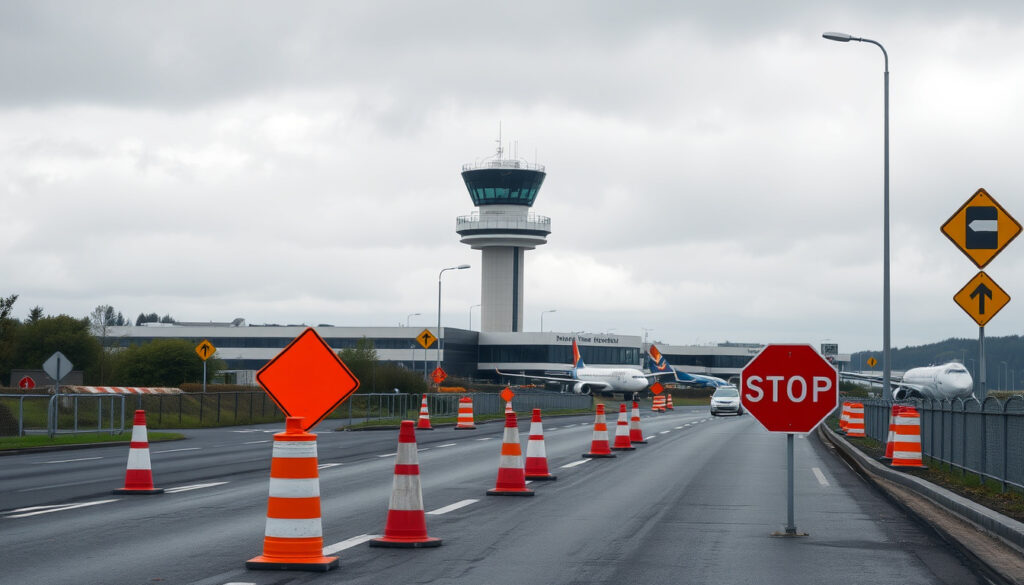
Traffic Control Course Ireland: ATC vs Temporary Management
If you’re looking at traffic control courses in Ireland, you’ve probably noticed two very different worlds: the high-stakes career of an air traffic controller and the hands-on trade of temporary traffic management. One takes years to break into, the other can get you on a worksite in three days.
Air traffic controller training duration: 18-24 months ·
Temporary traffic management course duration: 3 days ·
Minimum age for AirNav Ireland student controller programme: 19 years
Quick snapshot
- AirNav Ireland runs the Student Controller Programme, the sole ATC training path in Ireland (AirNav Ireland, state air navigation service)
- Temporary traffic management courses like CSCS SLG take 3 days through providers such as National Training Solutions (National Training Solutions, vocational training provider)
- Applicants for AirNav’s programme need a Leaving Certificate with 2 H5s or equivalent Level 5 NFQ qualification (AirNav Ireland) (AirNav Ireland, state air navigation service)
- AirNav pays student controllers €515 per week allowance from January 2026 until on-the-job training begins (AirNav Ireland) (AirNav Ireland, state air navigation service)
- Exact salaries for qualified air traffic controllers in Ireland are not published; estimates range from €45,000 to €60,000 based on public sector scales and Glassdoor.
- The real value of free traffic management courses depends on employer recognition — not all free certificates are accredited by bodies like CSCS or QQI.
- Pass rates and job placement statistics for temporary traffic management courses are not publicly disclosed by most providers.
- The exact number of applicants per AirNav recruitment cycle is not disclosed.
- AirNav runs up to two selection processes per year, typically in spring/summer (AirNav Ireland) (National Training Solutions)
- Full ATC training spans 18-24 months, including classroom, simulation and on-the-job phases (AirNav Ireland) (National Training Solutions)
- 3-day CSCS SLG course provides a CSCS card accepted on construction sites (National Training Solutions)
- AirNav is expected to open its next recruitment campaign in spring 2025. Apply early; competition is high.
- Free traffic management course certificates may gain or lose recognition — always verify with a recognised awarding body before enrolling.
Here are the essential facts in a quick-reference format.
| Label | Value | Source |
|---|---|---|
| Air traffic controller training provider | AirNav Ireland (Student Controller Programme) | AirNav Ireland |
| Temporary traffic management training provider | National Training Solutions, LASNTG | National Training Solutions |
| Typical duration for temporary traffic management course | 3 days | National Training Solutions |
| Minimum age for ATC programme | 19 years | AirNav Ireland |
| Qualification level for temporary traffic management | QQI Level 5 or 6 / CSCS card | Various providers |
| Student allowance (AirNav) | €515 per week from Jan 2026 | AirNav Ireland |
| Minimum Leaving Cert requirement (AirNav) | 2 H5s or equivalent Level 5 NFQ | AirNav Ireland |
How long does it take to become an air traffic controller in Ireland?
What is the AirNav Ireland student controller programme?
- AirNav Ireland’s Student Controller Programme is the only government-approved path to become an air traffic controller in the Republic of Ireland (AirNav Ireland).
- The programme combines classroom instruction at AirNav’s Training Centre in Shannon, County Clare, with simulation and on-the-job training at Dublin, Shannon, or Cork airports (AirNav Ireland).
- Applicants must be at least 19 years old when applying, because the training takes up to two years and a licensed controller must be 21 (AirNav Ireland).
How long is air traffic controller training in Ireland?
- AirNav states the entire Student Controller Programme lasts 18-24 months (AirNav Ireland).
- NATS, the UK’s equivalent provider, says its Level 5 apprenticeship for trainee air traffic controllers involves 1-18 months of college-based training (NATS, UK air traffic services provider).
- In Ireland, AirNav runs up to two selection processes per year, so timing your application matters (AirNav Ireland).
What are the stages of ATC training?
- Phase 1 (months 1-6): classroom and simulation training at AirNav’s Shannon centre.
- Phase 2 (months 7-18): on-the-job training (OJTI) at an operational unit.
- Phase 3 (months 18-24): final assessments and validation before full licensing.
Air traffic control training demands 18-24 months of commitment before earning a licence. That’s 6-8 times longer than a basic temporary traffic management certificate. The reward is a career starting around €45,000, but you’re competing for a handful of places each year.
The implication: ATC demands a long-term commitment, while TTM is a quick entry.
What do you need to become a traffic control?
What qualifications are required for an air traffic controller?
- AirNav Ireland explicitly requires a Leaving Certificate with a minimum of 2 H5s, or an equivalent second-level qualification covering mathematically based subjects (AirNav Ireland).
- The educational standard must be at least Level 5 on the National Framework of Qualifications (NFQ) (AirNav Ireland).
- Applicants must also pass a Class 3 medical examination and a series of aptitude tests.
What skills are needed for temporary traffic management?
- Entry-level CSCS courses (Sign Light and Guarding, SLG) require no prior experience — just physical fitness and a basic understanding of road safety (National Training Solutions).
- LASNTG offers QQI-validated Temporary Traffic Management Training programmes that also accept beginners (LASNTG, local authority training network).
Are there any age or medical requirements?
- AirNav: must be 19-35 years old, pass Class 3 medical. Effective 16 January 2026 the upper age limit is 35 (AirNav Ireland).
- For temporary traffic management: no upper age limit reported; basic fitness suffices for most roles.
For a 19-year-old finishing school, air traffic control is an option if you meet the Leaving Cert bar and are patient enough for a two-year process. For anyone looking to start earning quickly in construction, a 3-day SLG course is the fastest entry point — no prior qualifications required.
What this means: Your choice depends on time, patience, and educational background.
How much does an air traffic controller get paid in Ireland?
What is the starting salary for an air traffic controller in Ireland?
- AirNav Ireland does not publish exact salary figures for qualified controllers. Based on public sector pay scales and Glassdoor estimates, starting salaries typically range from €45,000 to €60,000.
- During training, students receive a weekly allowance of €515 from January 2026 (AirNav Ireland).
How does ATC salary compare to temporary traffic management roles?
- Temporary traffic management workers typically earn €15–€20 per hour at entry level, depending on contract and certification.
- Experienced traffic management supervisors or designers (Level 1) can earn higher rates, but the ceiling is lower than ATC.
Are there additional allowances or benefits?
- AirNav controllers may qualify for shift allowances, location allowances (Dublin, Cork, Shannon) and pension benefits common in public sector roles.
- Temporary traffic management roles are often contract-based with fewer benefits; some employers offer overtime rates for night work.
Bottom line: An air traffic controller earns roughly 3-4 times the hourly rate of a temporary traffic management worker, but the path to that salary requires 18-24 months of unpaid training (with a €515 weekly allowance from 2026). The trade-off is job security versus flexible, quickly accessible work.
The pattern: Higher earnings come with longer training and stricter entry requirements.
Which course is best to get a job quickly?
Is a free traffic control course certificate worth it?
- Free courses exist but may lack accreditation from recognised bodies like CSCS or QQI. Without a recognised certificate, employers may not accept it for site work.
- Always check that a free course delivers a valid CSCS card or QQI certification before enrolling.
What are the fastest traffic management courses in Ireland?
- The CSCS Sign Light and Guarding (SLG) course is the fastest: 3 days, leading to a CSCS card recognised on construction sites (National Training Solutions).
- CSCS Health and Safety at Roadworks is a 1-day course, but it is narrower in scope.
How do temporary traffic management courses compare to ATC training?
- ATC training: 18-24 months, highly competitive, university-level material.
- TTM courses: 1-3 days, open entry, vocational.
- ATC leads to a lifelong professional licence; TTM certificates are valid for 3-5 years before needing renewal.
A 3-day SLG course gets you working fast, but you’re competing with hundreds of other cardholders for daily labouring roles. Air traffic control offers a stable, salaried career with progression, but you might wait years for acceptance and training completion.
The implication: Speed of entry must be weighed against career stability.
What should you know before taking a traffic control course?
What is the difference between air traffic control and traffic management courses?
- Air traffic control: university-level or through AirNav, leading to a career managing aircraft movements. Requires strong maths and spatial awareness.
- Temporary traffic management: vocational courses focused on roadworks safety (signs, barriers, traffic control). More hands-on, less academic.
What accreditation should I look for?
- For ATC: AirNav Ireland is the sole recognised training body. Some universities (e.g., DCU) offer related degrees but they do not replace AirNav’s programme.
- For TTM: Look for QQI (NFQ Level 5 or 6) or CSCS (SLG, LUGS, etc.) accreditations.
How do I choose between online and in-person training?
- Online courses may cover theory (e.g., roadworks legislation) but practical assessments for CSCS cards typically require in-person attendance.
- AirNav’s training is entirely in-person due to simulation and safety requirements.
If you want a career with growth and pay progression, invest in ATC training. If you need income fast and are comfortable with physical work, a 3-day TTM course is the better bet. Know your accreditation before you pay a cent.
What this means: Your choice should align with your long-term goals and timeline.
Comparison: Air traffic control vs. Temporary traffic management
Three key differences separate these two paths — duration, earnings potential, and entry requirements.
This table highlights the core differences between the two paths.
| Factor | Air traffic control (AirNav) | Temporary traffic management |
|---|---|---|
| Training duration | 18-24 months | 1-3 days |
| Minimum education | Leaving Cert 2 H5s (NFQ Level 5) | None for entry-level |
| Earnings (starting) | €45,000-€60,000 (after licensing) | €15-€20 per hour |
| Certification | AirNav licence (lifelong with reviews) | CSCS card / QQI (3-5 year validity) |
| Age limits | 19-35 | No upper limit reported |
| Job stability | Permanent public sector | Contract-based, seasonal |
Upsides
- ATC: High salary, pension, professional status
- ATC: Lifelong career with progression
- TTM: Fast entry, low barrier to start
- TTM: Multiple short courses available across Ireland
Downsides
- ATC: Long, competitive training; age cap at 35
- ATC: No salary during training (only €515/week allowance from 2026)
- TTM: Lower earnings ceiling, less job security
- TTM: Certificates expire and require renewal
The takeaway: Each path offers clear advantages and trade-offs; your personal situation determines the better fit.
Step-by-step: How to start your traffic control career
Choosing the right path means knowing the steps involved. Here’s a clear breakdown for both routes.
To become an air traffic controller in Ireland
- Check you meet the requirements: age 19-35, Leaving Cert with 2 H5s (or equivalent), medical fitness.
- Monitor AirNav Ireland’s careers page for the next recruitment cycle (spring/summer).
- Submit your application and pass the aptitude tests and interview.
- If accepted, begin the 18-24 month Student Controller Programme in Shannon.
- Complete on-the-job training at Dublin, Shannon, or Cork and obtain your licence.
To start in temporary traffic management
- Choose a recognised provider — National Training Solutions, LASNTG, or a QQI-accredited centre.
- Enrol in a CSCS SLG course (3 days) or a 1-day Health and Safety at Roadworks course.
- Complete the training and pass the assessment to receive your card or certificate.
- Apply for labouring or traffic management roles on construction sites.
- Renew your certification every 3-5 years as required.
The pattern: Both paths have clear, sequential steps — the difference is in duration and competition.
Timeline: Air traffic controller vs Temporary traffic management
See how the timelines compare at a glance.
| Stage | ATC path (AirNav) | TTM path |
|---|---|---|
| Age 19+ | Eligible to apply | No age restriction |
| Application | Annual spring/summer campaign | Open enrolment year-round |
| Training start | Months 1-6: classroom + simulation | Day 1: 3-day course begins |
| Training end | Months 7-18: on-the-job training | Day 3: certification received |
| Employment | Month 18-24: final assessments, full licence | Immediate start possible |
What this means: The timeline difference is stark: months of training versus days.
What’s confirmed and what’s unclear
Confirmed facts
- AirNav Ireland is the sole provider of air traffic controller training in Ireland (AirNav Ireland).
- Temporary traffic management courses typically take 3 days for SLG certification (National Training Solutions).
- Minimum age for ATC programme is 19 (AirNav Ireland).
- Student controllers receive €515/week allowance from Jan 2026 (AirNav Ireland).
What’s unclear
- Exact salary figures for air traffic controllers are not publicly listed; estimates from similar public sector roles and Glassdoor are used.
- The value of free course certificates depends on employer recognition; not all free courses are accredited.
The implication: Verified facts come from official sources; uncertainty remains around pay and free course credibility.
Expert perspectives
“We recruit air traffic controllers through our Student Controller Programme and applicants must be at least 19 years of age.”
AirNav Ireland Careers, state air navigation service
“Our CSCS Sign Light and Guarding (SLG) course lasts 3 days.”
National Training Solutions, vocational training provider
“LASNTG has achieved QQI validation for Temporary Traffic Management Training programmes.”
LASNTG, local authority training network
The pattern: These sources confirm the training durations and providers.
Summary
Two paths, two very different timelines. Air traffic control offers a stable, well-paid career for those willing to invest 18-24 months and meet strict entry criteria. Temporary traffic management gets you earning in days but with lower pay and less security. For the construction worker looking to start tomorrow, the 3-day SLG course is the practical choice. For the school-leaver aiming high, AirNav’s programme is the only game in town — just don’t wait until you’re 36.
Frequently asked questions
What are the entry requirements for an air traffic controller course in Ireland?
You need a Leaving Certificate with 2 H5s (or an equivalent Level 5 NFQ qualification with maths), be aged 19-35, pass a Class 3 medical, and succeed in AirNav’s aptitude tests and interview.
Can I take a traffic control course online?
Some theoretical portions are available online, but CSCS and QQI certifications require in-person practical assessments. AirNav’s ATC training is entirely in-person due to simulation needs.
How much does a temporary traffic management course cost?
Costs vary by provider. Expect to pay €200-€500 for a 3-day CSCS SLG course. Some providers offer free courses, but check accreditation before enrolling.
Is there an age limit for temporary traffic management training?
No official upper age limit has been reported. Basic fitness is the main requirement for most roles.
What certification do I need to work as a traffic controller on Irish roads?
For temporary traffic management on public roads, a CSCS card (SLG, LUGS) or a QQI Level 5/6 certificate in Temporary Traffic Management is commonly required.
How do I renew my CSCS traffic management card?
CSCS cards are valid for 3-5 years. Renewal usually involves a short refresher course and a new test. Check with your training provider for specific renewal options.
Are there part-time traffic control courses available?
Most temporary traffic management courses are full-time over 1-3 days. AirNav’s ATC programme is full-time. Some providers offer weekend courses for CSCS certification; check availability locally.
More related posts
 Lily Collins: Biography, Health, Family, Surrogacy & Films
 Ethan Hawke: Relationships, Career, and Family Facts
 Fish Sauce: What It Is, Health Effects, Substitutes & Uses
 The Four Seasons Netflix Series: Season 2, Cast, and Key Questions Answered
 Jensen Huang Biography: Net Worth, Wife, and Nvidia Journey
 Vijay Deverakonda: Movies, Net Worth, Relationship Rumors
 Jack Whitehall: Biography, Relationship, Net Worth & More
 Aaron Chen: Age, Height, Net Worth, Partner, and Comedy Career
