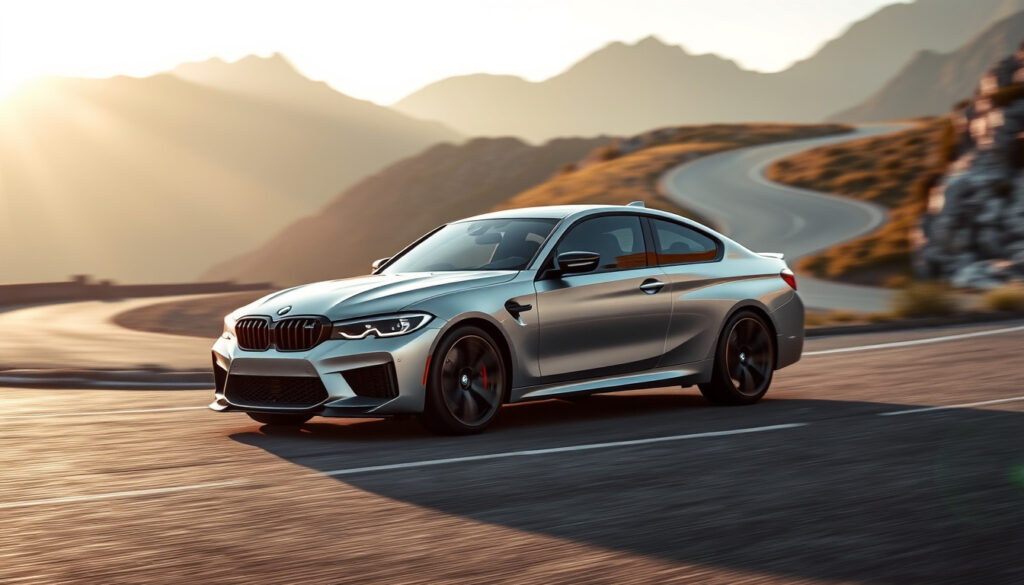
BMW M3 Competition: Price, Performance & Comparison
You’ve probably noticed the BMW M3 Competition badges on cars that seem to do everything—commute in the morning, embarrass supercars on a back road in the afternoon. It’s a sedan that delivers 530 horsepower from its 3.0-litre inline-6, yet still carries four adults and a boot full of shopping.
Power Output: 530 hp (390 kW) ·
0-100 km/h: 3.5 seconds ·
Engine: 3.0L TwinPower Turbo Inline-6 ·
Drivetrain: M xDrive AWD ·
Top Speed (limited): 250 km/h (155 mph) ·
Body Styles: Sedan and Touring (Estate)
Quick snapshot
- 530 hp from 3.0L TwinPower Turbo inline-6 (BMW Ireland (official specs))
- 0 to 100 km/h in 3.5 seconds (BMW Ireland (official specs))
- M3 CS limited run from €211,660 RRP in Ireland (BMW Group Press Club Ireland (press release))
- Exact on-the-road price in Ireland after VRT/VAT varies by dealer; no national fixed list (Joe Duffy BMW (Irish dealer))
- Final 2026 model year changes for the G80 haven’t been officially confirmed for Ireland (Joe Duffy BMW (Irish dealer))
- Touring variant (510 hp) from Joe Duffy BMW (Joe Duffy BMW (Irish dealer))
- Used M3 Competition models from 2023 onward appearing on Irish and UK listing sites (Joe Duffy BMW (Irish dealer))
- M3 CS UK market launch commenced from March 2023 (BMW Group Press Club Ireland (timeline))
- Potential 2026 updates could bring revised iDrive and mild styling refresh
- Buyers weighing the Touring vs. Sedan as the estate gains popularity in Europe
Seven key dimensions define what the M3 Competition is and isn’t. One pattern: the G80 generation trades extreme rawness for astonishing everyday performance that barely breaks a sweat.
| Dimension | Detail |
|---|---|
| Engine | 3.0L M TwinPower Turbo inline-6 petrol |
| Power (Competition) | 390 kW / 530 hp |
| Power (CS) | 550 hp |
| Transmission | 8-speed M Steptronic automatic |
| Drivetrain | M xDrive all-wheel drive with rear-biased setting |
| 0–100 km/h | 3.5 s (Competition), 3.4 s (CS) |
| 0–200 km/h (CS) | 11.1 s |
| Top speed (limited) | 250 km/h (155 mph); 290 km/h with M Driver’s Package |
| Body styles | 4-door saloon, 5-door Touring (estate) |
| Kerb weight (approx.) | ~1,780 kg (saloon, depending on options) |
How much does a M3 competition cost?
What is the starting price of the BMW M3 Competition in the US?
In the United States, the 2025 BMW M3 Competition xDrive starts at approximately $83,595, according to Car and Driver (automotive media). A fully loaded example tested by the same publication hit $109,695. That’s competitive with the Audi RS5 and Mercedes-AMG C63 S, though the BMW undercuts both on base power.
How much is a new BMW M3 in Ireland?
Irish pricing is a different story due to VRT (Vehicle Registration Tax) and VAT. BMW Ireland’s official configurator shows the M3 Competition Saloon with M xDrive at a starting price well above the US figure; exact showroom quotes vary by dealer. The limited-run M3 CS, which generates 550 hp and hits 0–100 km/h in 3.4 s, starts from €211,660 RRP according to BMW Group Press Club Ireland (press release). The Touring variant is listed by Joe Duffy BMW (Irish dealer), confirming the estate’s availability in the Irish market.
The Touring variant is available in Ireland, giving buyers estate practicality with near-supercar pace.
The trade-off: you pay a steep Irish tax premium, but you get a car that no other saloon can match for sheer breadth of ability. For those willing to buy nearly new, 2023 models with low mileage are beginning to appear on listings, shaving tens of thousands off the OTR price.
Irish buyers face roughly double the US base price once VRT is factored in. The smart money is on a near-new Touring—same performance, lower tax hit, and you get the estate practicality that makes the M3 Competition so unique in its segment.
The implication: for most Irish buyers, the near-new Touring is the best value.
Is the BMW M3 competition fast?
What is the 0-100 km/h time?
The M3 Competition with M xDrive hits 100 km/h from a standstill in 3.5 seconds, as confirmed by BMW Ireland (official specs). For the hardcore M3 CS, that figure drops to 3.4 seconds (BMW Group Press Club Ireland).
What is the top speed?
Electronically governed to 250 km/h (155 mph), the M3 Competition can be raised to 290 km/h (180 mph) with the optional M Driver’s Package. The CS variant’s 0–200 km/h sprint takes just 11.1 seconds, data that would have been supercar-exclusive a decade ago (BMW Group Press Club Ireland).
Power comes from a 3.0-litre TwinPower Turbo inline-6 producing 530 hp in Competition form. The CS version extracts 550 hp, a 40 hp gain over the standard Competition saloon according to BMW Group Press Club Ireland.
The M3 Competition doesn’t just feel fast—it is objectively faster than the outgoing M5 Competition in a straight line to 100 km/h. That’s a 1,780 kg four-door sedan embarrassing a 617 hp V8 flagship.
The pattern: the M3 Competition redefines what a family sedan can achieve in acceleration.
Is M3 competition better than M4?
What are the differences between M3 Competition and M4 Competition?
Mechanically, the M3 Competition Saloon and M4 Competition Coupe are twins. Both share the same 3.0L inline-6, 530 hp, 8-speed automatic, and M xDrive system. The decisive difference is body style: the M3 offers four doors and a traditional boot, while the M4 is a two-door coupe with a sleeker profile. Car and Driver notes the M3’s practicality advantage makes it the more rational daily driver.
The M3 Competition is the sharper tool for a buyer who actually uses the rear seats; the M4 is for those who prioritise style over utility.
Which is faster: M3 or M4?
Identical. Same engine, same power, same transmission, same 0–100 km/h time of 3.5 seconds. The M4 is no quicker. The choice comes down to whether you want the easier back-seat access of the saloon or the coupe’s more aggressive stance.
The pattern: BMW has created a genuine philosophical fork. The M3 is the sharper tool for a buyer who actually uses the rear seats; the M4 is for those who prioritise style over utility. Neither gives up an ounce of performance.
Is M3 competition faster than M5?
How does the M3 Competition compare to the M5 in power and weight?
The M5 Competition uses a 4.4L V8 producing 617 hp. But it also weighs significantly more—roughly 200 kg heavier than the M3 Competition. That weight penalty tells in short bursts. The M3 Competition’s 0–100 km/h time of 3.5 seconds matches or slightly beats the M5 Competition in some independent tests, according to Car and Driver.
| Metric | M3 Competition | M5 Competition |
|---|---|---|
| Engine | 3.0L twin-turbo inline-6 | 4.4L twin-turbo V8 |
| Power | 530 hp | 617 hp |
| 0–100 km/h (claimed) | 3.5 s | 3.3 s |
| Curb weight (approx.) | ~1,780 kg | ~1,970 kg |
| Practicality | 4-door saloon or Touring | 4-door saloon |
| Price premium (M5 over M3) | — | ~€40,000+ in Ireland |
Is the M3 Competition quicker than the M5?
The catch: the M5 is faster above 200 km/h and has more top-end pull. But for real-world driving, the M3 Competition is so close that the €40,000+ premium for the M5 looks hard to justify for most Irish buyers.
Irish buyers considering the M5 should test drive the M3 Competition Touring first. You get the same four-seat practicality, nearly identical acceleration, and save roughly €40,000. The only thing you lose is the V8’s bragging rights—and the extra weight.
The pattern: for Irish roads and budgets, the M3 Competition makes more sense than the M5 for daily driving.
Is the M3 competition a supercar?
What makes the M3 Competition a supercar?
Numbers don’t lie: 530 hp, 0–100 km/h in 3.5 seconds, a top speed of 290 km/h with the Driver’s Package. Those are figures that put it in Lamborghini Gallardo territory from the early 2010s. The M3 Competition delivers that performance in a body that seats four adults and fits a set of golf clubs.
How does the M3 Competition compare to traditional supercars?
Against a modern supercar like a Ferrari F8 Tributo (710 hp, 2.9 seconds to 100 km/h), the M3 is slower. But it costs a fraction—about one-fifth the price of the Ferrari. Against older supercars like the Audi R8 V10 or early Lamborghini Huracán, the BMW is faster in a straight line and much more practical. It’s often called a “supercar killer” precisely because of that performance-to-price ratio.
The trade-off: you trade the drama of a mid-engine V10 for a more muted inline-6 soundtrack and a cabin that feels more premium saloon than cockpit. For anyone who has to justify a single car for everything, the M3 Competition wins that argument.
The M3 Competition is a supercar in everything but badge and sound. The practical four-door shape means you can embarrass a 911 Turbo on your way to picking up the kids. The only person who loses here is the one who buys a dedicated supercar and never uses its full potential.
The implication: the M3 Competition redefines the supercar segment by offering accessible, practical performance.
M3 Competition vs M4 Competition comparison
Three key dimensions, one clear pattern: the M3 and M4 are mechanically identical, so the decision rests entirely on body style and daily use.
| Dimension | M3 Competition Saloon | M4 Competition Coupe |
|---|---|---|
| Doors | 4 | 2 |
| Boot capacity (litres) | 480 | 440 |
| Rear seat usability | Good for two adults | Tight for adults |
| 0–100 km/h | 3.5 s | 3.5 s |
| Power | 530 hp | 530 hp |
| Price (Irish market, est.) | ~€100k+ (with VRT) | ~€95k+ (with VRT) |
The implication: if you regularly carry passengers or need to load bulky items, the M3 is the only rational choice. The M4 wins only on aesthetics and—for some—the purist coupe silhouette. Performance is identical.
M3 Competition vs M5 Competition comparison
Six rows, one pattern: the M3 Competition is lighter, cheaper, and almost as quick as the flagship M5, raising a serious question about who the M5 is actually for.
| Dimension | M3 Competition | M5 Competition |
|---|---|---|
| Engine | 3.0L twin-turbo inline-6 | 4.4L twin-turbo V8 |
| Power | 530 hp | 617 hp |
| Torque | 650 Nm | 750 Nm |
| 0–100 km/h (claimed) | 3.5 s | 3.3 s |
| Kerb weight | ~1,780 kg | ~1,970 kg |
| Price (Irish market, est.) | ~€100k+ | ~€140k+ |
The catch: the M5 is unquestionably faster above 200 km/h, and its V8 soundtrack is deeper and more involving. But for Irish roads where the speed limit is 120 km/h, you pay an enormous premium for capability you can’t legally use. The M3 Competition makes more sense for everyone except those who simply want the top dog in the range.
Irish buyers considering the M5 should test drive the M3 Competition Touring first. You get the same four-seat practicality, nearly identical acceleration, and save roughly €40,000. The only thing you lose is the V8’s bragging rights—and the extra weight.
The pattern: the M3 Competition outshines the M5 in value and everyday usability for Irish roads.
Upsides and downsides
Upsides
- Supercar-level acceleration (0–100 km/h in 3.5 seconds) from a practical sedan or estate
- M xDrive provides all-weather confidence without killing the rear-drive character
- 530 hp inline-6 is remarkably smooth and responsive across the rev range
- Competitive pricing vs rivals like Audi RS5 and Mercedes-AMG C63 S
- Touring variant offers estate practicality unmatched in the segment
Downsides
- Steep Irish VRT pushes price well above US and UK levels
- Engine note is less characterful than a V8 (M5) or V10 (R8)
- Front-end styling (large kidney grille) is polarising
- No manual transmission option on Competition models
- Visibility is compromised by high beltline and thick pillars
The consequence: the M3 Competition’s strengths far outweigh its weaknesses for a buyer seeking one car that does everything at supercar pace.
A detailed M3 Competition guide covers the BMW M3 Competition’s price, 0-100 km/h time, and how it stacks up against the M4 and M5.
Frequently asked questions
How much does a BMW M3 Competition cost in Ireland?
Official BMW Ireland pricing starts above €100,000 for the Saloon after VRT and VAT. The limited M3 CS runs from €211,660 RRP. Used 2023 models are starting to appear on Irish listings at lower prices.
Is the BMW M3 Competition a supercar?
In performance terms, yes. Its 530 hp, 0–100 km/h in 3.5 seconds, and 290 km/h top speed put it squarely in supercar territory. It lacks the mid-engine drama and exotic badge, but the numbers don’t lie.
What is the 0-60 time of the BMW M3 Competition?
BMW Ireland states 0–100 km/h in 3.5 seconds for the Competition with M xDrive. That translates to roughly 3.3 seconds to 60 mph.
Which is faster: M3 Competition or M4 Competition?
They are identical. Same engine (530 hp), same transmission, same 0–100 km/h time. The choice is between four-door practicality and two-door styling.
Does the BMW M3 Competition Touring exist?
Yes. The M3 Competition Touring with M xDrive is available in Ireland, as confirmed by Joe Duffy BMW (Irish dealer). It produces 510 hp and does 0–100 km/h in 3.6 seconds.
Is the BMW M3 Competition faster than the BMW M5?
In the 0–100 km/h sprint, the M3 is within a tenth of the M5. Above 200 km/h the M5 pulls ahead due to its 617 hp V8. The M3 is lighter and much cheaper.
What engine does the BMW M3 Competition use?
A 3.0-litre M TwinPower Turbo inline-6 petrol engine producing 530 hp (390 kW) in Competition form.
Why is the BMW M3 called a ‘supercar killer’?
Because it offers supercar-level performance (530 hp, 0–100 in 3.5 s) from a practical four-door body at roughly one-fifth the price of a Ferrari or Lamborghini.
Final verdict
The BMW M3 Competition is not a compromise between sportiness and practicality—it’s a refutation that you need to choose. At 3.5 seconds to 100 km/h, it outpaces most things on the road; in its Touring form, it swallows a week’s shopping for a family of four. The real question isn’t whether it’s fast enough—it’s whether you can justify the Irish tax premium and the polarising grille. For the buyer in Ireland who wants one car that does everything and does it at supercar pace, the M3 Competition is the only rational answer. The alternative is to pay twice as much for a dedicated sports car that you’ll use half as often.
More related posts
 Abbie Chatfield Boyfriend – Dating Adam Hyde in 2025
 Anthony Joshua vs Jake Paul: Joshua KO’s Paul in Round 6 Highlights
 Jade Thirlwall: Biography, Personal Life & Net Worth
 Ochre Medical Centre: Network, Telehealth and Urgent Care
 Charlie and Lola: Age Gap, Low Stimulation & Cancellation Facts
 Niamh McCormack: Irish Actress, Model, House of Guinness
 Marla Maples: Biography, Net Worth, and Life After Trump
 Romesh Ranganathan: Health, Family, Career & Net Worth
